+ Reply to Thread
Page 1 of 2 12 LastLast
Results 1 to 10 of 15

Thread: A large two way speaker system paiyng homage to the KEF BBC LS5/1AE

  1. #1
    Join Date: Dec 2013

    Location: Suffolk

    Posts: 128
    I'm Simon.

    Lightbulb A large two way speaker system paiyng homage to the KEF BBC LS5/1AE

    My design for a larger two way speaker system paying homage to the KEF BBC LS5/1AE

    This is an idea to create a modern speaker very loosely based on the KEF BBC LS5/1AE

    I happen to own a pair of these excellent speakers and as a speaker building fanatic have been inspired to build a big two way system.

    I have a weak spot for big two way speakers, having owned a pair of Spendor SA3s for a number of years. I still have these.

    There is also the BBC LS5/8 whilst I have heard them a few times I have never heard the PM510 made by Rogers which was the passive version.

    The LS 5/1AE is larger then the SA3 and the LS5/8 and used a 15" Bass unit crossing over to a pair of Rola Celestion HF1300s at 1.7 Khz

    A brief description of the LS 5/1AE here.

    1 Goodmans C129/15pr or 1 Plessey (LS5/1), 15-inch paper cone woofer.

    2 x Rola-Celestion HF1300 tweeters

    Large reflex enclosure net volume 135 Litres tuned to around 40 Hz with a 91mm x 66mm slot 19 mm deep.

    History

    Raymond Cooke, the founder of KEF in 1961, had close links to the BBC dating back to his time in the BBC Engineering Designs Department in the early 1950s,

    where he worked with influential sound engineers such as Dudley Harwood and D.E.L.Shorter.

    This connection was re-established in the early 1960s when KEF signed an agreement to manufacture the BBC designed LS5/1A monitor under licence to the corporation

    production continued into the mid 1970s.

    Also manufactured during this period were the LS5/2, LS3/4 and the 3-way LS5/5 – for which KEF also manufactured the 12” bass and 8” midrange drivers.

    KEF's meticulous approach to production engineering was well suited to the manufacture of these tight tolerance monitors.

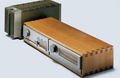
    My pair is from 1968 or so pictures here the internals are not mine, but the rest are my actual speakers.


    Internal pictures


    My speakers


    My idea here is to build a big two way using a 15" Bass unit and a pair of tweeters.

    I propose to use a pair of the Audax TW034X0 units crossed over at around 1.5 Khz -6 dbs and to incorporate the 15" bass unit in at -6dbs 1.5 Khz

    Similar to the LS5/1AE, my design will use a parallel pair of tweeters, this is used to get the power handling around crossover and a little above.

    Searching for a bass driver that

    1/ has good sound quality

    2/ has a smooth enough response that it can be used up to -6dbs 1.5 Khz

    My thoughts are this unit Precision Devices PD.153C01

    Though it is a sensitive unit, a bass alignment can be chosen and crossover equalisation (tuning with additional series inductance with parallel resistance)

    can bring that down somewhat more inline with the tweeters.

    Rogers (Swiistone Electronics) did something similar with the equalisation used in the LS5/8 system and the PM510 passive equivalent.

    This set of curves from the BBC LS5/8 design

    The bass driver used has a rising response


    The top curve is a measure of the response output from the 12" bass driver mounted in the enclosure. The bass driver has a rising response which can be flattened by using series inductance with parallel resistance with it.

    The second is the equalisation required to achieve a flatter response.

    The third the desired result.

    These two drivers have a response that matched the rogers 12" in terms of a rising midband response

    http://www.eighteensound.com/Product...id/3366/15w930

    This one being closer

    http://www.eighteensound.com/Product...d/3365/15nd930

    What will make thus fun is that the drivers quoted thus far are a real unknown as far as sound quality is concerned.

    This makes selection very difficult unless sound quality is known!!
    Last edited by darkmatter; 16-02-2016 at 15:16.

  2. #2
    Audio Al is offline Pishanto Specialist & Super-Daftee
    Join Date: May 2012

    Location: Dagenham Essex

    Posts: 11,184
    I'm Allen.

    Default

    Does the damping material work inside plastic bags I thought it should absorb / Damp , with a barrier between the wadding can't see how its doing its job

    Maybe just me being a numpty

    The crossover looks impressive
    [

  3. #3
    Join Date: Aug 2009

    Location: Staffordshire, England

    Posts: 43,351
    I'm Martin.

    Default

    Quote Originally Posted by Audio Al View Post
    Does the damping material work inside plastic bags I thought it should absorb / Damp , with a barrier between the wadding can't see how its doing its job
    Your sofa still damps the room even with a fabric 'barrier' around the cushions.

    Looks like an interesting speaker, treading a bit of a tightrope with the crossover point though?
    Current Lash Up:

    TEAC VRDS 701T > Sony TAE1000ESD > Krell KSA50S > Troels Gravesen Faital 3WC-15.

  4. #4
    Join Date: Feb 2008

    Location: Middlesex, UK

    Posts: 4,481
    I'm Alex.

    Default

    Quote Originally Posted by Audio Al View Post
    Does the damping material work inside plastic bags I thought it should absorb / Damp , with a barrier between the wadding can't see how its doing its job

    Maybe just me being a numpty

    The crossover looks impressive
    I thought the same, perhaps the "bags" were added later as a safety measure.
    Spendorman

  5. #5
    Join Date: May 2008

    Location: A Strangely Isolated Place in Suffolk with Far Away Trains Passing By...

    Posts: 14,540
    I'm David.

    Default

    The bags are there to stop the wadding/wool migrating - my LS5/9's have the damping sheets actually in ventilated plastic bags, would you believe and they're not even stuck to the inside of the cabinets (I think there's bitumen there too, but it's a few years since I took them apart to look).


    A couple of points if I may... 15" main drivers have obvious advantages, but dispersion higher up isn't one of them. Ideally, non Tannoys of this size need you to sit a few metres away so the drive units can integrate. the 'special commission' Spendor SA3 was reviewed and its problems discussed in a Hifi Choice review (I have both the passive and active reviews). The LS5/1 would have another huge problem, in that the HF1300's don't go down low enough and pairing them up ads to the dispersion issue - possibly - although the Beeb would have been using them under very controlled conditions in then well designed studios, so this may have not been an issue.

    As for LS5/8's. Something happened to them from the drawing board to final production and all of them have an upper mid suckout which is quite pronounced and audible away from the studio - all documented with evidence both subjective and objective, on the HUG. The smaller 5/9's were finished off to sort-of mimic this and although it's not bad when they're sited in free space on 20" stands, pushed closer to a back wall, the mid bass dominates very badly and they sound very ripe and plump, if not as thick and lush toned as good working Spendor SP2's in direct comparison - in my experience of course. We did have the Chartwell passive version to try (or was it the PM450 which may have been different - apologies) -- and these were awful, dull and bland sounding things.

    Good luck anyway. Modern tweeters do work down lower now and also go higher, so crossing over may not be the issue it once was. have a look at Eminence pro drivers too, as their larger ones (for guitars I believe) can be very smooth with no nasties and with huge power handling, together with an excellent sound on music as well as intended purpose.

    Last edited by DSJR; 14-02-2016 at 15:50.
    I can't go on and I can't go back, I don't feel so matter of fact,
    I tried and tried to make good sense, What's the good to try it all again?

  6. #6
    Join Date: Feb 2008

    Location: Middlesex, UK

    Posts: 4,481
    I'm Alex.

    Default

    Still not convinced by plastic bags covering the absorbent material. Tannoy in their early speakers put the damping in what looks like cotton bags.

    Nice big magnet on that bass unit!

    Only just thought, the Ditton 25 has similarities, 12" bass unit, two Celestion HF1300's, but an HF2000 as a super tweeter.
    Spendorman

  7. #7
    Join Date: May 2008

    Location: A Strangely Isolated Place in Suffolk with Far Away Trains Passing By...

    Posts: 14,540
    I'm David.

    Default

    Mid and low frequencies will travel straight through the plastic, where as hf won't and will be reflected - not an issue when there's absolutely no hf inside the box - at least I think that's how it goes...
    I can't go on and I can't go back, I don't feel so matter of fact,
    I tried and tried to make good sense, What's the good to try it all again?

  8. #8
    Join Date: Feb 2008

    Location: Middlesex, UK

    Posts: 4,481
    I'm Alex.

    Default

    I have often wondered about the sort of cling film dust covers in the ESL57 and ESL63, but they seem to work transmitting the HF and MF.
    Spendorman

  9. #9
    Join Date: Dec 2013

    Location: Suffolk

    Posts: 128
    I'm Simon.

    Default

    Quote Originally Posted by DSJR View Post
    Mid and low frequencies will travel straight through the plastic, where as hf won't and will be reflected - not an issue when there's absolutely no hf inside the box - at least I think that's how it goes...
    That is as I understand it too

  10. #10
    Join Date: Dec 2013

    Location: Suffolk

    Posts: 128
    I'm Simon.

    Default

    Quote Originally Posted by DSJR View Post
    The bags are there to stop the wadding/wool migrating - my LS5/9's have the damping sheets actually in ventilated plastic bags, would you believe and they're not even stuck to the inside of the cabinets (I think there's bitumen there too, but it's a few years since I took them apart to look).


    A couple of points if I may... 15" main drivers have obvious advantages, but dispersion higher up isn't one of them. Ideally, non Tannoys of this size need you to sit a few metres away so the drive units can integrate. the 'special commission' Spendor SA3 was reviewed and its problems discussed in a Hifi Choice review (I have both the passive and active reviews). The LS5/1 would have another huge problem, in that the HF1300's don't go down low enough and pairing them up ads to the dispersion issue - possibly - although the Beeb would have been using them under very controlled conditions in then well designed studios, so this may have not been an issue.

    As for LS5/8's. Something happened to them from the drawing board to final production and all of them have an upper mid suckout which is quite pronounced and audible away from the studio - all documented with evidence both subjective and objective, on the HUG. The smaller 5/9's were finished off to sort-of mimic this and although it's not bad when they're sited in free space on 20" stands, pushed closer to a back wall, the mid bass dominates very badly and they sound very ripe and plump, if not as thick and lush toned as good working Spendor SP2's in direct comparison - in my experience of course. We did have the Chartwell passive version to try (or was it the PM450 which may have been different - apologies) -- and these were awful, dull and bland sounding things.

    Good luck anyway. Modern tweeters do work down lower now and also go higher, so crossing over may not be the issue it once was. have a look at Eminence pro drivers too, as their larger ones (for guitars I believe) can be very smooth with no nasties and with huge power handling, together with an excellent sound on music as well as intended purpose.
    Very good points made the HF 1300s were paired to get power handling and then the lower unit was rolled off around 5 K or so

    Eminence make some interesting drivers will have to look through their catalog any suggestions welcome one did come to mind the

    http://www.adamhall.com/en/Eminence_...0_W_8_Ohm.html

    It has a smooth albeit rising response which could be equalised as described in the first post the response reminds me of the 12" unit used in the LS5/8

+ Reply to Thread
Page 1 of 2 12 LastLast

Tags for this Thread

Posting Permissions

  • You may not post new threads
  • You may not post replies
  • You may not post attachments
  • You may not edit your posts
  •