+ Reply to Thread
Page 1 of 15 12311 ... LastLast
Results 1 to 10 of 150

Thread: Valve sound versus solid state...

  1. #1
    Join Date: Feb 2008

    Location: South Wales

    Posts: 9,148
    I'm NotTakingLifeTooSeriouslyTheseDays.

    Default Valve sound versus solid state...

    HI ALL,
    it was felt by some that this subject needed to be explored further and explained in more detail, so after thinking about it, and writing a lot, i decided that it would be better to start this thread off with an invitation for you guys to to tell us what amplification your using, ie, valve, or solid state, and what it is about your choice that works for you. hopefully this way it will start the thread off in good spirit, so without further a do lets get things started...
    anthony,TD...

  2. #2
    Join Date: Jan 2008

    Location: Wrexham, North Wales, UK

    Posts: 110,448
    I'm AudioAl'sArbiterForPISHANTO.

    Default

    Dear Mr Matthews,

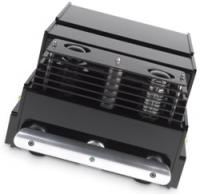
    I've got this rather old 30W Copper valve amp thingy that I found behind my sofa amongst some stale Jaffa cakes and a half-eaten muffin. It sounds rather good though and appears to outperform a pair of 200W solid-state monoblocks I also own. Could you explain what's going on?

    Yours in astonishment,

    Hilda.
    Main System

    Turntable: Heavily-modified Technics SL-1210MK5G [Mike New bearing/ETP platter/Paul Hynes SR7 PSU & regulator mods]. Funk Firm APM Achromat with Nagaoka GL-601 Crystal Record Weight. Isonoe feet & boots. Ortofon RS-212D tonearm with Denon DL-103GL, in a Denon PCL-300 headshell, fitted with Funk Firm Houdini and Kondo SL-115 pure-silver cartridge leads.

    Paul Hynes MC head amp/SR5 PSU. Also modded Lentek head amp and Denon AU-310 SUT.

    Other Cartridges: Nippon Columbia (NOS 1987) Denon DL-103. USA-made Shure SC35C with NOS stylus. Goldring G820 with NOS stylus. Shure M55E with NOS stylus.

    CD Player: Audiocom-modified Sony X-777ES/DAS-R1 DAC.

    Tape Deck: Tandberg TCD 310, fully restored and recalibrated as new by RDE, plus upgraded with heads from the TCD-420a. Also with matching TM4 Norway microphones.

    Preamps: Heavily-modified Croft Charisma-X. Power Amps: Tube Distinctions Copper Amp, fitted with Tungsol KT-150s. Quad 306.

    Cables & Sundries: Mark Grant HDX1 interconnects and digital coaxial cable, plus Mark Grant 6mm UP-LCOFC Van Damme speaker cable. MCRU 'Ultimate' mains leads. Lehmann clone headphone amp with vintage Koss PRO-4AAA headphones.

    Tube Distinctions digital noise filter. VPI HW16.5 record cleaning machine.

    Speakers: Tannoy 15MGs in Lockwood cabinets with modified crossovers. 1967 Celestion Ditton 15.

  3. #3
    Join Date: Feb 2008

    Location: http://www.homehifi.co.uk

    Posts: 6,289

    Default

    I use a power amp fitted with unobtanium V-FETs. Warm and sizeable bottom, solid and round front.

  4. #4
    Join Date: Feb 2008

    Location: South Wales

    Posts: 9,148
    I'm NotTakingLifeTooSeriouslyTheseDays.

    Default

    Quote Originally Posted by Marco View Post
    Dear Mr Matthews,

    I've got this rather old 30W Copper valve amp thingy that I found behind my sofa amongst some stale Jaffa cakes and a half-eaten muffin. It sounds rather good though and appears to outperform a pair of 200W solid-state monoblocks I also own. Could you explain to me what's going on?

    Yours in astonishment,

    Hilda.
    ok mr scotyital smarty pants,
    here are some of the reasons and observations that are shared by many [including me] for reverting back to valves for audio.

    Valve amplifiers be it single ended or push-pull, have long been thought of by many as superior beasts to solid state…whether their use be musical instrument related, or purely for audio replay, but what is it that still makes them more desirable to a growing number of musicians and audiophiles world wide than often the best of what solid state has to offer?

    Well, here are some positive reasons. First off, valve designs produce predominantly low order harmonics (which is musically related); while solid state designs generally produce a full range of harmonic distortion, including the objectionable high order harmonics. This is due to a number of factors, including the transformer output of valve designs, and the large amounts of negative (electronic) feedback required in solid state designs, in comparison, valve designs need very little negative feedback, and some good sounding amps don't use any at all!

    Circuit design undoubtedly plays an important role, valve circuits are often less complex and laid out differently, therefore It can be argued that simplicity is usually best, as the length and complexity can change the inductance and capacitance of a circuit. A more complex circuit will have a more complex sonic distortion characteristic. Minimalist single ended valve amps for example typically have a dominant very simple harmonic distortion spectrum. Complex modern transistor designs often have low level but extremely complex harmonic distortion spectra.

    Another advantage of most valve amplifier designs is the high input impedance typically 100k in modern designs and as much as 1 Meg ohm in classic designs. By contrast, solid state amplifiers may have much lower input impedances, some as low as 20k This implies that it requires more energy to excite the input of a typical transistor amplifier to any given voltage than it does a typical valve amplifier. If sensitivity to small signals is a significant goal, then valve designs will typically outperform transistor designs.

    Valve amplifiers in general do not need to use as much negative feedback as transistor amplifiers, and while some will argue [and rightly so in some cases] that the absence of negative feedback slightly increases harmonic distortion, by limiting the amount of negative feedback, it avoids instability, as well as slew rate and bandwidth limitations imposed by dominant-pole compensation in transistor amplifiers.

    Valves versus transistors when driven hard distort quite differently, and it is well known and documented that valves clip more softly than transistors therefore allowing higher levels of distortion to be tolerated whilst still being able to portray the complex harmonic structure of for example a musical instrument..
    i await your constructive comments.
    anthony,TD...

    Last edited by anthonyTD; 17-01-2009 at 20:17.

  5. #5
    Join Date: May 2008

    Location: Cricklewood

    Posts: 9,074
    I'm ILOB.

    Default

    I used to to think Valve amps were for the wolley jumper and slippers brigrade great mid but no bass and dynamics I went through many Solid state amps and would not even think about a valve amp.
    Now I have a SAC Glowmaster it has more controlled bass, dyamics detail and larger soundstage than my old Gamut D200 MK3 but only is rated at 66watts I do not really understand this
    Also I read it encourages something called 2nd Harmonics which are very pleasing to the ear; is this artical warmth or ? As the music sounds natural to me
    Last edited by John; 17-01-2009 at 19:47.
    Loves anything from Pain of Salvation to Jeff Buckley to Django to Sarasate to Surinder Sandhu to Shawn Lane to Nick Drake to Rush to Beth Hart to Kate Bush to Rodrigo Y Gabriela to The Hellecasters to Dark Sanctury to Ben Harper to Karicus to Dream Theater to Zero Hour to Al DiMeola to Larry Carlton to Derek Trucks to Govt Mule to?

    Humour: One of the few things worth taking seriously

  6. #6
    Join Date: Feb 2008

    Location: South Wales

    Posts: 9,148
    I'm NotTakingLifeTooSeriouslyTheseDays.

    Default

    Quote Originally Posted by John View Post
    I used to to think Valve amps were for the wolley jumper and slippers brigrade great mid but no bass and dynamics I went through many Solid state amps and would not even think about a valve amp.
    Now I have a SAC Glowmaster it has more controlled bass, dyamics detail and larger soundstage than my old Gamut D200 MK3 but only is rated at 66watts I do not really understand this
    Also I read it encourages something called 2nd Harmonics which are very pleasing to the ear; is this artical warmth or ? As the music sounds natural to me
    hi john,
    its good to hear that all the perceived negative traits you mention above about your earlier informed but rather misguided view of valve amplifiers have now been put to rest, the more people i speak with who have recently converted to valves have similar stories to tell, so your far from alone in your experiences.
    as for your confusion about the diffrence in percieved power ie, valve amplifiers seemingly having more power than an equaly matched watt for watt solid state amp, well i have my views on that too, but i would rather hold fire and give some of the other guys a chance to give their views on this for the moment.
    anthony,TD...

  7. #7
    Join Date: Aug 2008

    Location: Suffolk, UK

    Posts: 1,468
    I'm Paul.

    Default

    Here's an interesting point to think about.

    I have found that the earthing scheme of an amp can have a huge impact on the quality of its sound, not just hum and earth loops.

    Almost all solid state amps are PCB based, almost all valve amps are hard wired.

    A hard wired amp will tend to have much thicker (lower impedance) earth wiring compared to the tracks of a pcb.
    ~Paul~

  8. #8
    Join Date: Nov 2008

    Location: Banbury, Oxfordshire/Panteg is where my late father was born

    Posts: 4,381
    I'm Chris.

    Default

    I used valve amps for 15 years, and currently have a CA 740 not because i prefer solid state' its just i don't have the finances for a quality valve set up' i got the CA for a bargain price.

    I did have a concordant valve pre with Audio Innovations 2nd audio mono(2a3) with border patrol psu's which was just wonderful it just sounded so big and there if you know what i mean, one point i would make regarding valve amps is that some like the 2nd audio's used solid state rectifiers, which caused the amp to sound loose and flabby with complex music' so when looking at valve amps' valve rectified choke smoothing is a must .

  9. #9
    Join Date: Feb 2008

    Location: Edinburgh

    Posts: 311

    Default

    I just want a cheap as chips fully balanced valve pre which will drive two balanced outputs, and a few very powerful fully balanced valve power amps capable of driving difficult loads with lots of output 300w - 600w) and silent operation with 103db speakers, none of that background hiss or hum please, oh and bass must be proper, not that overblown under damped bass which people thinks sounds better.

    By cheap as chips I mean comparable in price to a Yamaha E800 processor (silent) driving a brace of Alesis RA-500 bridged amps.

    Cheers..

  10. #10
    Join Date: Mar 2008

    Posts: 112

    Default

    Quote Originally Posted by anthonyTD View Post
    ok mr scotyital smarty pants,
    here are some of the reasons and observations that are shared by many [including me] for reverting back to valves for audio.

    Valve amplifiers be it single ended or push-pull, have long been thought of by many as superior beasts to solid state…whether their use be musical instrument related, or purely for audio replay, but what is it that still makes them more desirable to a growing number of musicians and audiophiles world wide than often the best of what solid state has to offer?

    Well, here are some positive reasons. First off, valve designs produce predominantly low order harmonics (which is musically related); while solid state designs generally produce a full range of harmonic distortion, including the objectionable high order harmonics. This is due to a number of factors, including the transformer output of valve designs, and the large amounts of negative (electronic) feedback required in solid state designs, in comparison, valve designs need very little negative feedback, and some good sounding amps don't use any at all!

    Circuit design undoubtedly plays an important role, valve circuits are often less complex and laid out differently, therefore It can be argued that simplicity is usually best, as the length and complexity can change the inductance and capacitance of a circuit. A more complex circuit will have a more complex sonic distortion characteristic. Minimalist single ended valve amps for example typically have a dominant very simple harmonic distortion spectrum. Complex modern transistor designs often have low level but extremely complex harmonic distortion spectra.

    Another advantage of most valve amplifier designs is the high input impedance typically 100k in modern designs and as much as 1 Meg ohm in classic designs. By contrast, solid state amplifiers may have much lower input impedances, some as low as 20k This implies that it requires more energy to excite the input of a typical transistor amplifier to any given voltage than it does a typical valve amplifier. If sensitivity to small signals is a significant goal, then valve designs will typically outperform transistor designs.

    Valve amplifiers in general do not need to use as much negative feedback as transistor amplifiers, and while some will argue [and rightly so in some cases] that the absence of negative feedback slightly increases harmonic distortion, by limiting the amount of negative feedback, it avoids instability, as well as slew rate and bandwidth limitations imposed by dominant-pole compensation in transistor amplifiers.

    Valves versus transistors when driven hard distort quite differently, and it is well known and documented that valves clip more softly than transistors therefore allowing higher levels of distortion to be tolerated whilst still being able to portray the complex harmonic structure of for example a musical instrument..
    i await your constructive comments.
    anthony,TD...
    I agree with all of the above.

    My own preference is to start with the most linear amplifying device possible, the triode and build amplifiers around that. That way we need to apply less of a band aid - negative feedback. The poor linearity of transistors means that circuit complexity increases, with feedback being almost mandatory and I believe this is a large factor in the sound.

    When I built my 801A amp, as designed it had 2-3dB NFB, but, when I diconnected this sound quality improved. With NFB is sounded very clean and colourless, but without, all the timbre a vitality can back. It wasn't all positive and the bass became somewhat looser, but to me the trade off was well worth it.

    I also agree that the spectrum of THD matters a lot as well as the absolute level, with low even order being preferred. Nelson Pass has done some ineteresting work there with the F1 & F2 designs , with one being PP and one being SE, thus having different distortion spectrums and different 'flavours'. I recently heard an F3 and it was very, very good indeed - sweet and grainless, a good alternativer for those who would like a SET, but don't want valves. Mind you, it's still hot and low powered.

    Sorry for the brain dump!

+ Reply to Thread
Page 1 of 15 12311 ... LastLast

Tags for this Thread

Posting Permissions

  • You may not post new threads
  • You may not post replies
  • You may not post attachments
  • You may not edit your posts
  •