+ Reply to Thread
Page 166 of 195 FirstFirst ... 66116156164165166167168176 ... LastLast
Results 1,651 to 1,660 of 1947

Thread: Macca's Lash Up 2: Lash Harder

  1. #1651
    Join Date: Nov 2011

    Location: Seaton, Devon, UK

    Posts: 13,636
    I'm Adrian.

    Default

    Quote Originally Posted by Macca View Post
    Thanks - I did already read some tutorials but you know what it's like - what seems straightforward on paper isn't so easy when you actually come to do it
    Hi Martin,

    As you may have seen on other threads I have played around with REW to try and improve the listening experience in SQ in my slightly challenging room, large glass windows each side of a rectangle. Having worked in a Sound and Vibration lab many years ago I had some acoustics measurement knowledge up front but I am no expert or a sound engineer. What REW did enable me to do in this house and the previous one was identify where things were bad acoustically. Mainly reverb and certain frequencies and re-enforced bass. I spent some weeks experimenting with materials and temporary wall hangings until I got what I thought was the best result I could and still be acceptable to Sue, SWMBO. It is a worth while thing to do IMHO to get the most you can from your room and setup.

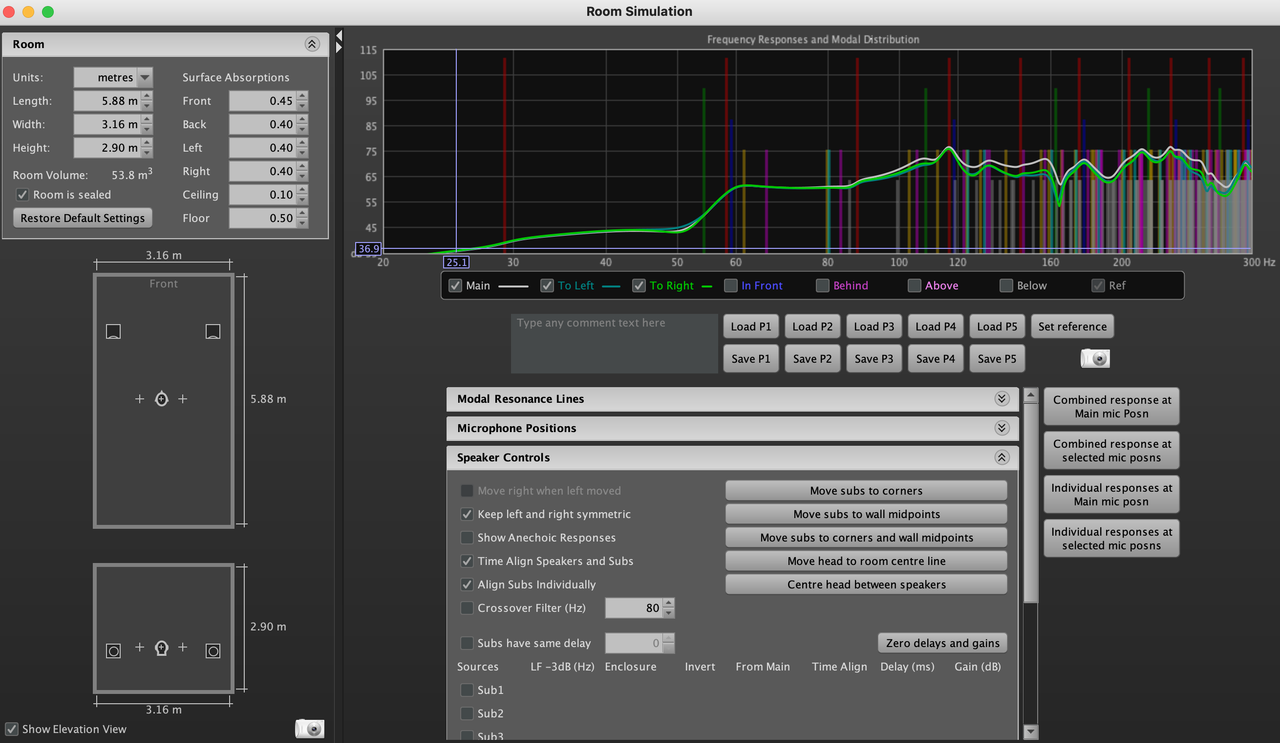
    First I would go to the Room Sim and enter your room dimensions and speaker positions, and 2 mic positions one for each ear. This will result in a frequency graph which will estimate the Frequency response 20hz to 300hz, you can now play around with speaker positions and listening positions trying to get a reasonably flat response, you can drag the head and speakers and see the graph change in real time. Once you have and idea of the best speaker and listening position onto the next step below.

    The easiest and most effective thing to use in REW are Reverb time RT60 and EDT(Estimated Time Delay). https://www.roomeqwizard.com/help/he...raph_rt60.html To do this after setting up your microphone at your listening position and calibrating it, you do this by playing a 20-20hz sweep from your computer through your hifi and recording it with REW, there is a simple help on how to calibrate the mic.

    Next take a frequency sweep with your room as it is normally and when done look at RT60, look at the EDT graph and what you would like to see is that across the frequency sweep that it stays below 300ms, the lower the better, but all a zero would sound very dead. So you can then adjust speaker position, listening position and room treatments and take further sweep readings and compare results until you get it as best as you can. I would use your ears as well by listening to only a couple of tracks that have clear drums, bass, vocal, and 2 or 3 other instruments, you should hear changes as you go, some subtle and others more prominent.

    One thing that can really help with acoustics in a room are curtains or a book case behind the listening position, I put CD shelving there with gapping, and soft furnishings dotted about, mirrors, TVs and other hard surfaces are not great. Any thing on the other walls to stop reflections helps, I purchased a couple of 60cm by 60cm simple pictures from TK Max and put 30mm of acoustic foam in the frames behind them, and put on the wall behind the speaker, it helped. As most acoustic sites will tell you moving speakers out from the wall is best but a lot do not say how far, I found this very helpful https://www.cardas.com/system-setup if you can get close for your room you will have a good starting point. What I found surprising was how small changes could make quite big improvements. It takes a bit of trial and error, and there will be some compromise, unless you have the luxury of a dedicated listening room. Also experimenting with speaker toe in angles is very useful, I found it could improve acoustics as I could not move my speakers more that 40cm out from side walls for daily use.

    I suspect you might already know quite a lot of the above but hope it is helpful.

    Below are examples of my room measurements


    Listening is the act of aural discrimination and dissemination of sound, and accepting you get it wrong sometimes.

    Analog Inputs: Pro-Ject Signature 10 TT & arm, Benz Micro LP-S, Michel Cusis MC, Goldring 2500 and Ortofon Rondo Blue cartridges, Hitachi FT5500 mk2 Tuner

    Digital:- Marantz SA-KI Pearl CD player, RaspberryPi/HifiBerry Digi+ Pro, Buffalo NAS Drive

    Amplification:- AudioValve Sunilda phono stage, Krell KSP-7B pre-amp, Krell KSA-80 power amp

    Output: Wilson Benesch Vector speakers, KLH Ultimate One Headphones

    Cables: Tellurium Q Ultra Black II RCA & Chord Epic 2 RCA, various speaker leads, & links


    I think I am nearing audio nirvana, but don’t tell anyone.

  2. #1652
    Join Date: Aug 2009

    Location: Staffordshire, England

    Posts: 43,375
    I'm Martin.

    Default

    Quote Originally Posted by AJSki2fly View Post
    Hi Martin,

    As you may have seen on other threads I have played around with REW to try and improve the listening experience in SQ in my slightly challenging room, large glass windows each side of a rectangle. Having worked in a Sound and Vibration lab many years ago I had some acoustics measurement knowledge up front but I am no expert or a sound engineer. What REW did enable me to do in this house and the previous one was identify where things were bad acoustically. Mainly reverb and certain frequencies and re-enforced bass. I spent some weeks experimenting with materials and temporary wall hangings until I got what I thought was the best result I could and still be acceptable to Sue, SWMBO. It is a worth while thing to do IMHO to get the most you can from your room and setup.

    First I would go to the Room Sim and enter your room dimensions and speaker positions, and 2 mic positions one for each ear. This will result in a frequency graph which will estimate the Frequency response 20hz to 300hz, you can now play around with speaker positions and listening positions trying to get a reasonably flat response, you can drag the head and speakers and see the graph change in real time. Once you have and idea of the best speaker and listening position onto the next step below.

    The easiest and most effective thing to use in REW are Reverb time RT60 and EDT(Estimated Time Delay). https://www.roomeqwizard.com/help/he...raph_rt60.html To do this after setting up your microphone at your listening position and calibrating it, you do this by playing a 20-20hz sweep from your computer through your hifi and recording it with REW, there is a simple help on how to calibrate the mic.

    Next take a frequency sweep with your room as it is normally and when done look at RT60, look at the EDT graph and what you would like to see is that across the frequency sweep that it stays below 300ms, the lower the better, but all a zero would sound very dead. So you can then adjust speaker position, listening position and room treatments and take further sweep readings and compare results until you get it as best as you can. I would use your ears as well by listening to only a couple of tracks that have clear drums, bass, vocal, and 2 or 3 other instruments, you should hear changes as you go, some subtle and others more prominent.

    One thing that can really help with acoustics in a room are curtains or a book case behind the listening position, I put CD shelving there with gapping, and soft furnishings dotted about, mirrors, TVs and other hard surfaces are not great. Any thing on the other walls to stop reflections helps, I purchased a couple of 60cm by 60cm simple pictures from TK Max and put 30mm of acoustic foam in the frames behind them, and put on the wall behind the speaker, it helped. As most acoustic sites will tell you moving speakers out from the wall is best but a lot do not say how far, I found this very helpful https://www.cardas.com/system-setup if you can get close for your room you will have a good starting point. What I found surprising was how small changes could make quite big improvements. It takes a bit of trial and error, and there will be some compromise, unless you have the luxury of a dedicated listening room. Also experimenting with speaker toe in angles is very useful, I found it could improve acoustics as I could not move my speakers more that 40cm out from side walls for daily use.

    I suspect you might already know quite a lot of the above but hope it is helpful.

    Below are examples of my room measurements


    Thanks Ade - I do already have a fair bit of passive treatment, just to cure obvious issues like bounce from bare corners. Plus lots of thick curtains and carpet plus rugs on top.

    I can't put the speakers anywhere other than where they are - it is effectively a dedicated room but windows, doors, chimney breasts, stairs all get in the way. So I am relying on the PEQ to make any changes.

    With it being a large room there's no issue with bass boom or anything like that.

    Mainly doing this as I got in an argument with some youngsters on another forum who reckoned it was impossible to get a good sound without DRC. I pointed out that us oldies had no option of DSP for most of our audio careers so we had to learn how to pick speakers for the room, treat the room and so on. They just plonk any old thing down anywhere and twiddle a few knobs.

    Anyway they upshot was they wanted to see how it measured and ofc I had to confess I have never done that. So I am hoping it looks mint right off the bat
    Current Lash Up:

    TEAC VRDS 701T > Sony TAE1000ESD > Krell KSA50S > Troels Gravesen Faital 3WC-15.

  3. #1653
    Join Date: Nov 2011

    Location: Seaton, Devon, UK

    Posts: 13,636
    I'm Adrian.

    Default

    Quote Originally Posted by Macca View Post
    Thanks Ade - I do already have a fair bit of passive treatment, just to cure obvious issues like bounce from bare corners. Plus lots of thick curtains and carpet plus rugs on top.

    I can't put the speakers anywhere other than where they are - it is effectively a dedicated room but windows, doors, chimney breasts, stairs all get in the way. So I am relying on the PEQ to make any changes.

    With it being a large room there's no issue with bass boom or anything like that.

    Mainly doing this as I got in an argument with some youngsters on another forum who reckoned it was impossible to get a good sound without DRC. I pointed out that us oldies had no option of DSP for most of our audio careers so we had to learn how to pick speakers for the room, treat the room and so on. They just plonk any old thing down anywhere and twiddle a few knobs.

    Anyway they upshot was they wanted to see how it measured and ofc I had to confess I have never done that. So I am hoping it looks mint right off the bat
    I expect as you have used your ears and years of musical training listening to your collection it will be spot on, for your ears at least.[emoji2] it be interesting to see any measurements you do if you get tempted.


    Sent from my iPhone using Tapatalk
    Listening is the act of aural discrimination and dissemination of sound, and accepting you get it wrong sometimes.

    Analog Inputs: Pro-Ject Signature 10 TT & arm, Benz Micro LP-S, Michel Cusis MC, Goldring 2500 and Ortofon Rondo Blue cartridges, Hitachi FT5500 mk2 Tuner

    Digital:- Marantz SA-KI Pearl CD player, RaspberryPi/HifiBerry Digi+ Pro, Buffalo NAS Drive

    Amplification:- AudioValve Sunilda phono stage, Krell KSP-7B pre-amp, Krell KSA-80 power amp

    Output: Wilson Benesch Vector speakers, KLH Ultimate One Headphones

    Cables: Tellurium Q Ultra Black II RCA & Chord Epic 2 RCA, various speaker leads, & links


    I think I am nearing audio nirvana, but don’t tell anyone.

  4. #1654
    Join Date: Aug 2009

    Location: Staffordshire, England

    Posts: 43,375
    I'm Martin.

    Default

    Been having a bit of a play with the parametric EQ.

    Put in a 1dB dip right across the midrange, now going to have a listen and see what effect it has.

    Done this before with analogue EQ and it gave a more relaxed sound (think I do have a bit of a midrange lift due to speakers and room).

    Was iistening to some jazz yesterday and thought it was just a little bit bright and bass-shy so hoping this will correct that.
    Current Lash Up:

    TEAC VRDS 701T > Sony TAE1000ESD > Krell KSA50S > Troels Gravesen Faital 3WC-15.

  5. #1655
    Join Date: Aug 2009

    Location: Staffordshire, England

    Posts: 43,375
    I'm Martin.

    Default

    PEQ in action:


    I left the bass flat, put in a 1dB dip across the mids centered on 1Khz, with a bit of positive Q to reduce the bandwidth it covers. I messed about a bit with the slope on that too (which changes how steeply the cut rolls in) but couldn't hear a difference with that.

    Then I put in a 0.5dB boost centered around 10Khz with zero Q for the 'air and space'. That barely shows on the on-screen graph, but it's there.

    Handily you can adjust all the parameters, while music is playing, from the listening chair using the remote control.

    it's a nifty bit of kit given it's from 35 years ago.
    Current Lash Up:

    TEAC VRDS 701T > Sony TAE1000ESD > Krell KSA50S > Troels Gravesen Faital 3WC-15.

  6. #1656
    Join Date: Jun 2014

    Location: Chorley Lancs

    Posts: 19,338
    I'm Steve.

    Default

    That is quite nifty. All things considered, does this look like a keeper, or is it too early to tell? Overall, how does it compare to the Philips?
    I just dropped in, to see what condition my condition was in

    T/T: Inspire Monarch, X200 tonearm, Ortofon Quintet Blue. Phono: Project Tube Box CD: Marantz CD6006 (UK Edition); Amp: Musical Fidelity A5 Integrated.
    Speakers: KEF Reference 3, REL T9i subwoofer. Cables: Atlas Equator interconnects, Atlas Hyper 3.0 speaker cables

    T'other system:
    Echo Dot, Arcam A75 integrated, Monitor Audio R852 MD speakers
    A/V:
    LG OLED65 G56LS, Panasonic Blu Ray, Sony a/v amp, MA Radius speakers, REL T9i sub.


    KICKSTARTER: ENABLING SCAMMERS SINCE 2009

  7. #1657
    Join Date: Jan 2009

    Location: Essex

    Posts: 37,782
    I'm openingabottleofwine.

    Default

    I have the use of a Klark Technik DM360 30-way 1/3 octave equaliser. It is purely analogue and the smallest lift/cut that can be applied is about +/- 0.5dB.

    I have only ever applied changes of no more than +/- 1dB, covering various parts of the audio spectrum of 32Hz - 20kHz. In all cases audible changes were apparent, but none were obviously 'better'. So I just left things as they were: flat across the spectrum, and removed the equaliser from my system.
    Barry

  8. #1658
    Join Date: Jun 2014

    Location: Chorley Lancs

    Posts: 19,338
    I'm Steve.

    Default

    Quote Originally Posted by Barry View Post
    I have the use of a Klark Technik DM360 30-way 1/3 octave equaliser. It is purely analogue and the smallest lift/cut that can be applied is about +/- 0.5dB.

    I have only ever applied changes of no more than +/- 1dB, covering various parts of the audio spectrum of 32Hz - 20kHz. In all cases audible changes were apparent, but none were obviously 'better'. So I just left things as they were: flat across the spectrum, and removed the equaliser from my system.
    I suppose that's how it is, you can't 'fix' something that isn't broken. And it looks like your system already sounds right, so...

    I think Macca has a Klark Technik equaliser, but maybe the connections (balanced) aren't compatible with his kit. I'm sure he'll be along come tea time.
    I just dropped in, to see what condition my condition was in

    T/T: Inspire Monarch, X200 tonearm, Ortofon Quintet Blue. Phono: Project Tube Box CD: Marantz CD6006 (UK Edition); Amp: Musical Fidelity A5 Integrated.
    Speakers: KEF Reference 3, REL T9i subwoofer. Cables: Atlas Equator interconnects, Atlas Hyper 3.0 speaker cables

    T'other system:
    Echo Dot, Arcam A75 integrated, Monitor Audio R852 MD speakers
    A/V:
    LG OLED65 G56LS, Panasonic Blu Ray, Sony a/v amp, MA Radius speakers, REL T9i sub.


    KICKSTARTER: ENABLING SCAMMERS SINCE 2009

  9. #1659
    Join Date: Jan 2013

    Location: Birmingham

    Posts: 7,295
    I'm James.

    Default

    Interesting exercise I am sure but using EQ to "improve" aspects of the sound may result in unwanted headaches as you would almost need to do it for every recording?

  10. #1660
    Join Date: Aug 2009

    Location: Staffordshire, England

    Posts: 43,375
    I'm Martin.

    Default

    Quote Originally Posted by Pigmy Pony View Post
    That is quite nifty. All things considered, does this look like a keeper, or is it too early to tell? Overall, how does it compare to the Philips?
    As it stands I prefer the Topping with the Philips. But want to explore what I can do with the EQ first. Only just started playing about to get a feel for it at the moment.
    Current Lash Up:

    TEAC VRDS 701T > Sony TAE1000ESD > Krell KSA50S > Troels Gravesen Faital 3WC-15.

+ Reply to Thread

Posting Permissions

  • You may not post new threads
  • You may not post replies
  • You may not post attachments
  • You may not edit your posts
  •