+ Reply to Thread
Page 7 of 8 FirstFirst ... 5678 LastLast
Results 61 to 70 of 72

Thread: Why Cartridge set up is so important!

  1. #61
    Join Date: Jan 2009

    Location: Essex

    Posts: 37,755
    I'm openingabottleofwine.

    Default

    Can one hold a mobile phone at exactly the same height and in exactly the same orientation at each speaker?

    Agree about the second point you make, though I would expect the two channels of the amplifier to be within 0.1dB of each other. Speaker sensitivity is a different matter.
    Barry

  2. #62
    Join Date: Mar 2015

    Location: Finland

    Posts: 241
    I'm Kai.

    Default

    For adjusting azimuth, I would think measuring at speaker level is not accurate enough beyond "in the ballpark". There's just so many possible variables at that point, exact positioning of microphone, difference in sensitivity between speakers, power amplifier channel balance (likely very good though), volume pot (will vary across the range of the pot if a regular pot is used) & phono stage accuracy come to mind.

    All that ignores a big one which is alignment of various bits in the cartridge & alignment of stylus tip relative to coils (if talking MC cartridges) - there's good reason phono cartridges might only have a specified channel balance within 0.5dB or even worse, though I gotta say I'm not sure I've had any carts which were off by more than that.

    So, IMO for azimuth adjustment it's best to do it visually and adjust according to the diamond to get most accurate tracking. Also not all cartridges seem to age gracefully, it would seem sometimes things can get out of whack a bit as the suspension components age.

    I do think getting azimuth spot on is very important and here from tracking perspective there are no compromises, the better you do it, the better it gets, that simple. In a perfect world no arm would have azimuth adjustment, but would come out perfect from the factory, like all cartridges and we'd never have to worry about it. Sadly in the real world that is not the case. If the cartridge is not put together perfectly, then adjusting azimuth for the diamond you might end up sacrificing some channel separation at the generator. If that happens, it happens. If you have to twist the cartridge more than just the slightest bit for a very small fine tune, you might want to get in touch with either the seller of the cartridge or the manufacturer (assuming a new cart).

  3. #63
    Join Date: Nov 2011

    Location: Seaton, Devon, UK

    Posts: 13,636
    I'm Adrian.

    Default

    Quote Originally Posted by helma View Post
    For adjusting azimuth, I would think measuring at speaker level is not accurate enough beyond "in the ballpark". There's just so many possible variables at that point, exact positioning of microphone, difference in sensitivity between speakers, power amplifier channel balance (likely very good though), volume pot (will vary across the range of the pot if a regular pot is used) & phono stage accuracy come to mind.

    All that ignores a big one which is alignment of various bits in the cartridge & alignment of stylus tip relative to coils (if talking MC cartridges) - there's good reason phono cartridges might only have a specified channel balance within 0.5dB or even worse, though I gotta say I'm not sure I've had any carts which were off by more than that.

    So, IMO for azimuth adjustment it's best to do it visually and adjust according to the diamond to get most accurate tracking. Also not all cartridges seem to age gracefully, it would seem sometimes things can get out of whack a bit as the suspension components age.

    I do think getting azimuth spot on is very important and here from tracking perspective there are no compromises, the better you do it, the better it gets, that simple. In a perfect world no arm would have azimuth adjustment, but would come out perfect from the factory, like all cartridges and we'd never have to worry about it. Sadly in the real world that is not the case. If the cartridge is not put together perfectly, then adjusting azimuth for the diamond you might end up sacrificing some channel separation at the generator. If that happens, it happens. If you have to twist the cartridge more than just the slightest bit for a very small fine tune, you might want to get in touch with either the seller of the cartridge or the manufacturer (assuming a new cart).

    OK if we are going to approach this on a purely scientific approach, then we could adopt measurement of output from with the phono stage or the Pre-amp using a reasonably accurate Meter, alternatively by a Fozgometer which essentially does the same thing.

    I believe this is documented on several articles on the net. In simple terms it means paling the 300hz track and then with a suitable adapted cable plugged into one channel measuring the volt and then doing the same with the other and comparing then, then if different adjusting azimuth to get them the same. Then all should be good.

    If you were going to argue about differences in voltage between channels due to different components on circuits, then first you would send a sine wave signal at a known voltage into one channel and measure the output, and then do the same for the other, if there was a difference you would apply this ratio to the voltage adjust when you did the azimuth with the cartridge.

    Measuring differences on the cartridge engine are not so simple, although my Benz Micro LP-S came with such a measurement from the factory showing the response of each channel and that they are virtually identical from 20hz to 20Khz.
    Listening is the act of aural discrimination and dissemination of sound, and accepting you get it wrong sometimes.

    Analog Inputs: Pro-Ject Signature 10 TT & arm, Benz Micro LP-S, Michel Cusis MC, Goldring 2500 and Ortofon Rondo Blue cartridges, Hitachi FT5500 mk2 Tuner

    Digital:- Marantz SA-KI Pearl CD player, RaspberryPi/HifiBerry Digi+ Pro, Buffalo NAS Drive

    Amplification:- AudioValve Sunilda phono stage, Krell KSP-7B pre-amp, Krell KSA-80 power amp

    Output: Wilson Benesch Vector speakers, KLH Ultimate One Headphones

    Cables: Tellurium Q Ultra Black II RCA & Chord Epic 2 RCA, various speaker leads, & links


    I think I am nearing audio nirvana, but don’t tell anyone.

  4. #64
    Join Date: Jan 2009

    Location: Essex

    Posts: 37,755
    I'm openingabottleofwine.

    Default

    You claim the channel imblance with the Ortofon cartridge was 6dB, as measured by your phone app, yet the error in azimuth was around 4o. This does not make sense; the imbalance caused by a 4o error will be no more than 1.3dB.

    I agree the two channels of any self-respecting amplifier will be within 0.2dB of one another, and for most quality speakers the unit-to-unit variation in frequency response will be within 2dB. I have the pen plots for my B&W DM2a speakers, with consecutive serial numbers. You can lay the two plots over one another, and only by looking carefully can you see the occasional deviation of 1 - 2dB.

    I still maintain the best way to set up the azimuth is to either use a mirror (which will visually double any error) and/or play a mono record and check the image is narrow and centred midway between the two speakers.
    Barry

  5. #65
    Join Date: Nov 2011

    Location: Seaton, Devon, UK

    Posts: 13,636
    I'm Adrian.

    Default Why Cartridge set up is so important!

    How does 4o equate to 1.38dB.? I am only reporting what I see[emoji846]

    Perhaps the cart has other issues, it is about 12 years old, but it sounds fine aligned as it is.

    helma - I take your point but in a similar vain I do find using the mirror approach somewhat open to error, just as you say using a dB measurement.

    Firstly there is the issue of getting the mirror surface at the same height as the record surface for accuracy. When I have tried this method I found it very critical to be personally perfectly aligned to the cartridge/stylus or you are at risk of not seeing the actual angle in the mirror. Moving your head and eye position will introduce perception issues. Also I find it very difficult to believe any one, even a young person can accurately determine a stylus is absolutely 90o perpendicular to the mirror, the stylus is just too damn small to see it properly.

    Unfortunately it another one of these hifi issues for which there probably is not a definite answer, maybe taking several approaches together would give a better result to check more.
    Last edited by AJSki2fly; 14-07-2023 at 07:31.
    Listening is the act of aural discrimination and dissemination of sound, and accepting you get it wrong sometimes.

    Analog Inputs: Pro-Ject Signature 10 TT & arm, Benz Micro LP-S, Michel Cusis MC, Goldring 2500 and Ortofon Rondo Blue cartridges, Hitachi FT5500 mk2 Tuner

    Digital:- Marantz SA-KI Pearl CD player, RaspberryPi/HifiBerry Digi+ Pro, Buffalo NAS Drive

    Amplification:- AudioValve Sunilda phono stage, Krell KSP-7B pre-amp, Krell KSA-80 power amp

    Output: Wilson Benesch Vector speakers, KLH Ultimate One Headphones

    Cables: Tellurium Q Ultra Black II RCA & Chord Epic 2 RCA, various speaker leads, & links


    I think I am nearing audio nirvana, but don’t tell anyone.

  6. #66
    Join Date: Nov 2011

    Location: Seaton, Devon, UK

    Posts: 13,636
    I'm Adrian.

    Default

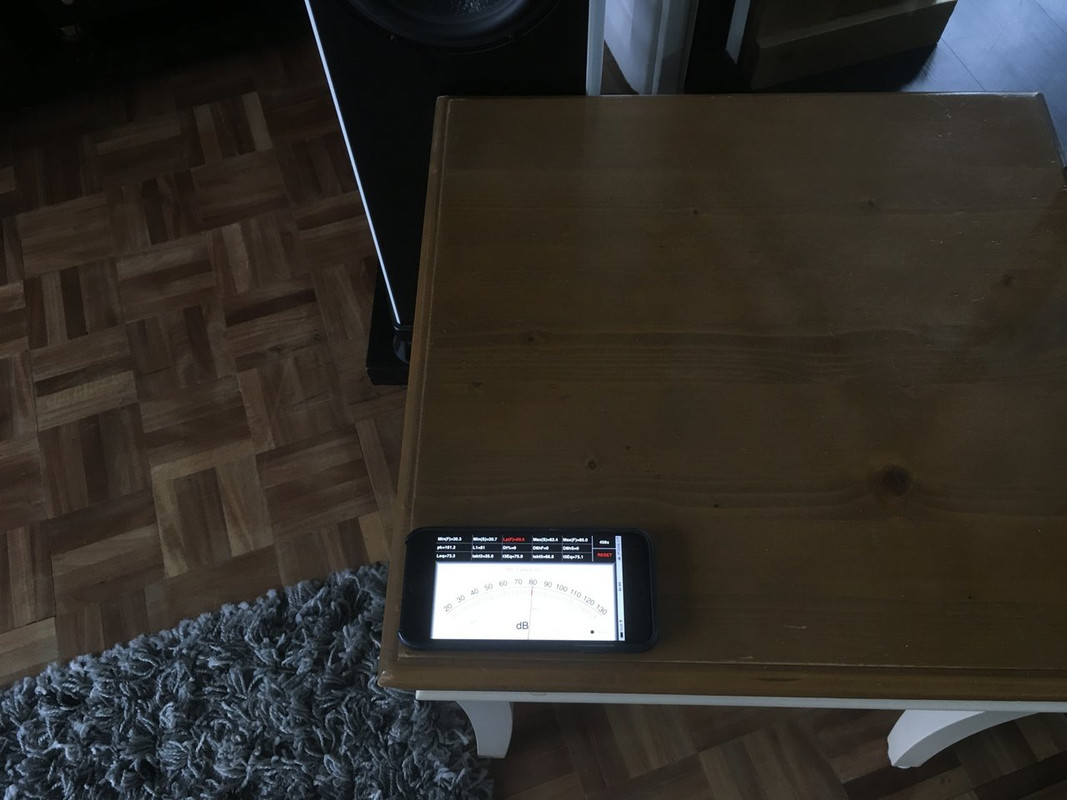
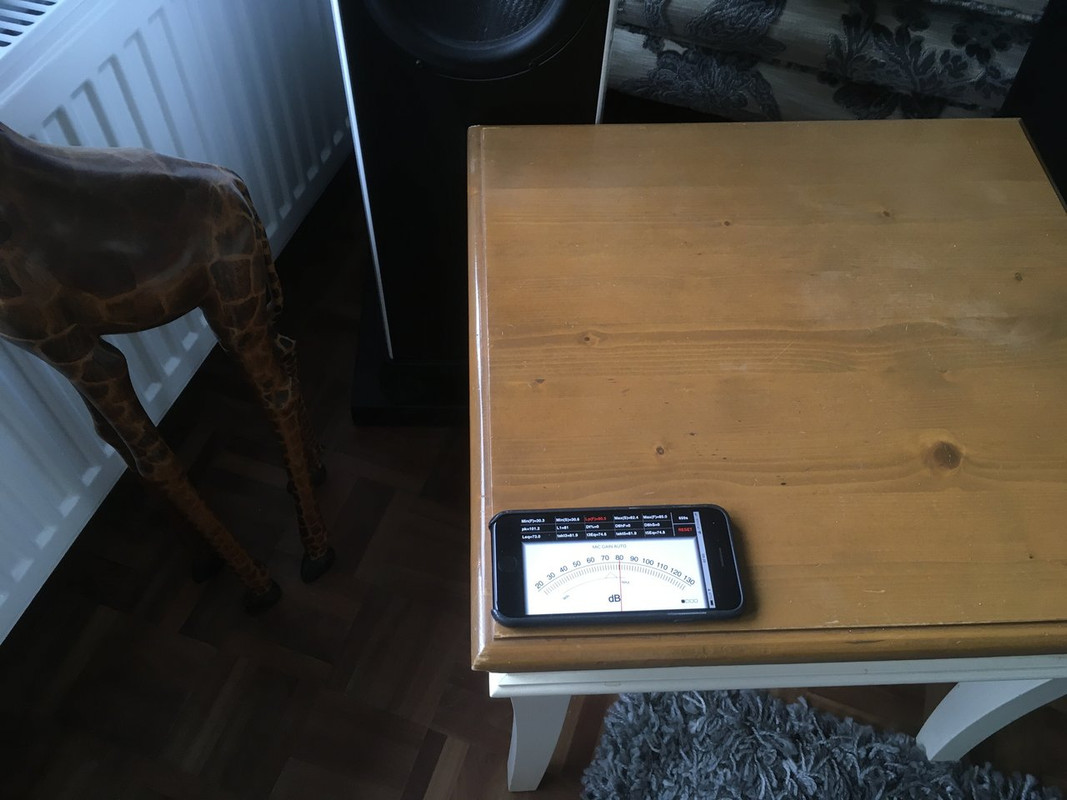
    OK so to settle in my own mind what I was doing and saying I did this and took photos of the dB measurements so you can see I introduce as little room for euro as possible.

    First I swapped my Rondo Blue over to the Benz Micro LP-S, this just meant switching head shells as they each were already mounted. I initially set up VTF, then I used as suggested the small mirror method for Azimuth, I adjusted the head shell alignment (it is one that has a grub screw and allow rotation). I carefully did so looking at the reflection in the mirror, I have to say that trying to evaluate the Stylus with normal eyesight is in my mind near impossible, and this was with it lit up with a light. I actual had to rely on the cartridge body image.

    I then checked the cartridge alignment with the perspex lined gauge for Azimuth and VTA(head shell horizontal), this looked good.

    As you can see from the photos below I next played the 300hz test track and measured to dB level for each speaker. Please not that I used a small table with the iPhone positioned in front of each speaker in exactly the same position, to minimise any discrepancies. As you can see both channels are spot on, which is what I would expect from this cartridge. The reason being is that I have checked the stylus using a digital microscope and the stylus looks to but as close to 90o to vertical from the cantilever as it can be.

    So using the mirror method where it was effectively relying on the body to align it to be parallel to the surface was likely to work, and set the Azimuth correctly, one caveat is if the stylus engine is mis-aligned or as others have said there are suspension issues, in which case seeing mis-alignment of the stylus in the mirror would be somewhat difficult.

    I will try and set up using an old cable and measure the voltages from each channel, to asses how close they are as well. I will them repeat the same with my other carts and see what I find.


    Last edited by AJSki2fly; 14-07-2023 at 16:43. Reason: Post same photo twice
    Listening is the act of aural discrimination and dissemination of sound, and accepting you get it wrong sometimes.

    Analog Inputs: Pro-Ject Signature 10 TT & arm, Benz Micro LP-S, Michel Cusis MC, Goldring 2500 and Ortofon Rondo Blue cartridges, Hitachi FT5500 mk2 Tuner

    Digital:- Marantz SA-KI Pearl CD player, RaspberryPi/HifiBerry Digi+ Pro, Buffalo NAS Drive

    Amplification:- AudioValve Sunilda phono stage, Krell KSP-7B pre-amp, Krell KSA-80 power amp

    Output: Wilson Benesch Vector speakers, KLH Ultimate One Headphones

    Cables: Tellurium Q Ultra Black II RCA & Chord Epic 2 RCA, various speaker leads, & links


    I think I am nearing audio nirvana, but don’t tell anyone.

  7. #67
    Join Date: Jan 2009

    Location: Essex

    Posts: 37,755
    I'm openingabottleofwine.

    Default

    Quote Originally Posted by AJSki2fly View Post
    How does 4o equate to 1.38dB.? I am only reporting what I see[emoji846]

    Perhaps the cart has other issues, it is about 12 years old, but it sounds fine aligned as it is.

    helma - I take your point but in a similar vain I do find using the mirror approach somewhat open to error, just as you say using a dB measurement.

    Firstly there is the issue of getting the mirror surface at the same height as the record surface for accuracy. When I have tried this method I found it very critical to be personally perfectly aligned to the cartridge/stylus or you are at risk of not seeing the actual angle in the mirror. Moving your head and eye position will introduce perception issues. Also I find it very difficult to believe any one, even a young person can accurately determine a stylus is absolutely 90o perpendicular to the mirror, the stylus is just too damn small to see it properly.

    Unfortunately it another one of these hifi issues for which there probably is not a definite answer, maybe taking several approaches together would give a better result to check more.
    Well actually, the imbalance caused by a 4o error in azimuth, whether due to the mis-mounting of the stylus on the cantilever, or in the orientation of the coils within the cartridge, is 1.22dB. I used a reasonable approximation to quickly derive the result I quoted (1.3dB); the correct result is 1.22dB.
    But to turn the question around - you claim the imbalance as measured by your phone was 6dB (that is the difference between the two readings). 6dB represents a voltage ratio of 2:1. I wouldn't have thought that would result from a mis-alignment of 4o; if it does there is something seriously wrong with the cartridge.


    Regarding the use of a mirror to set up the azimuth, I use one that is 2.1mm thick, which is that of a typical LP. We are not looking for any error in the alignment of the stylus mounted on the cantilever, but with cantilever when viewed head-on compared with its image in the mirror. So if there is an error, the image and its reflection are not continuous, but appear as a shallow "V". This can be easily seen, especially if a magnifying lens is used (such as one might use to set up the arm with an alignment protractor). By the way, at this stage the side bias is disabled, otherwise the cartridge/arm might 'skate' on the mirror.


    I see you have now corrected your post in showing both photos. However in the second photo, the phone appears to be normal to the speaker, whereas in the first the phone appears to be at an angle to the speaker. This probably doesn't matter, since at all audible frequencies, the internal microphone is largely omnidirectional. But it is something to consider.


    But we are going around in circles here - you are content with the way you set up azimuth with your phone app, as I am with my mirror and the use a monophonic record. We both have doubts about the accuracy of each other's method and find arguments both pro and con unconvincing, so perhaps it is best if we leave it there.
    Barry

  8. #68
    Join Date: Nov 2011

    Location: Seaton, Devon, UK

    Posts: 13,636
    I'm Adrian.

    Default

    Quote Originally Posted by Barry View Post
    Well actually, the imbalance caused by a 4o error in azimuth, whether due to the mis-mounting of the stylus on the cantilever, or in the orientation of the coils within the cartridge, is 1.22dB. I used a reasonable approximation to quickly derive the result I quoted (1.3dB); the correct result is 1.22dB.
    But to turn the question around - you claim the imbalance as measured by your phone was 6dB (that is the difference between the two readings). 6dB represents a voltage ratio of 2:1. I wouldn't have thought that would result from a mis-alignment of 4o; if it does there is something seriously wrong with the cartridge.


    Regarding the use of a mirror to set up the azimuth, I use one that is 2.1mm thick, which is that of a typical LP. We are not looking for any error in the alignment of the stylus mounted on the cantilever, but with cantilever when viewed head-on compared with its image in the mirror. So if there is an error, the image and its reflection are not continuous, but appear as a shallow "V". This can be easily seen, especially if a magnifying lens is used (such as one might use to set up the arm with an alignment protractor). By the way, at this stage the side bias is disabled, otherwise the cartridge/arm might 'skate' on the mirror.


    I see you have now corrected your post in showing both photos. However in the second photo, the phone appears to be normal to the speaker, whereas in the first the phone appears to be at an angle to the speaker. This probably doesn't matter, since at all audible frequencies, the internal microphone is largely omnidirectional. But it is something to consider.


    But we are going around in circles here - you are content with the way you set up azimuth with your phone app, as I am with my mirror and the use a monophonic record. We both have doubts about the accuracy of each other's method and find arguments both pro and con unconvincing, so perhaps it is best if we leave it there.
    Ever decreasing circles seems appropriate, smaller angles [emoji23]

    I think it’s worthwhile getting others views, I try and be open minded, and may find a better method, after all hifi is not an exact science, far too many variables.

    By the way forgot to mention before I took off the Rondo Blue I set it back to horizontal head shell position and re measured the dB difference between channels, I must have made a mistake previously it’s actually 3dB. So this makes a bit more sense.

    I will have another look at the mirror method next time and also let you know about voltage measurements.

    All the best, a vinyl idiot[emoji4]
    Listening is the act of aural discrimination and dissemination of sound, and accepting you get it wrong sometimes.

    Analog Inputs: Pro-Ject Signature 10 TT & arm, Benz Micro LP-S, Michel Cusis MC, Goldring 2500 and Ortofon Rondo Blue cartridges, Hitachi FT5500 mk2 Tuner

    Digital:- Marantz SA-KI Pearl CD player, RaspberryPi/HifiBerry Digi+ Pro, Buffalo NAS Drive

    Amplification:- AudioValve Sunilda phono stage, Krell KSP-7B pre-amp, Krell KSA-80 power amp

    Output: Wilson Benesch Vector speakers, KLH Ultimate One Headphones

    Cables: Tellurium Q Ultra Black II RCA & Chord Epic 2 RCA, various speaker leads, & links


    I think I am nearing audio nirvana, but don’t tell anyone.

  9. #69
    Join Date: Mar 2015

    Location: Finland

    Posts: 241
    I'm Kai.

    Default

    My "argument" for adjusting azimuth visually was/is that it ensures you are actually adjusting to get the best possible physical contact/alignment where the stylus meets the record. If you are adjusting according to cartridge output, then you are adjusting to get the generator best aligned. If the cartridge is perfect those two would be the same thing but in practice that's not always the case.

    I think when adjusting according to cartridge output, what you should be looking for would actually be channel separation, not channel balance, at least that's what I read somewhere and that's what a fozgometer seems to do. Trying to think about it seems to make sense for two reasons - I think a slight misalignment would first show up in channel separation before affecting the channel balance in a meaningful way and if the cantilever is slightly off-center, it would seem to me the azimuth could be perfect with best possible channel separation, yet channel balance could be slightly off because the coils are not centered. I might be wrong though, if I am hopefully someone will correct me

    The diamond is a very small thing, so it's not that all that easy to adjust azimuth visually, but not overly hard either. Barry explained above how to do it, taking a picture can help because you can then zoom in which makes it easier to see. You just have to make sure you are observing the cartridge directly from the front. I think even if doing the adjustment according to cartridge output, it would make sense to double check visually, just to be sure the diamond is mounted straight and that the cantilever isn't twisted.

    I think for majority of cartridges it doesn't really matter which way you do it, they are put together well enough any error is probably less than can be reliably observed visually but I have encountered a few where that was not the case.

  10. #70
    Join Date: Feb 2013

    Location: W Lothian

    Posts: 98,920
    I'm Grant.

    Default

    i always did it by eye and ear. have tried some other methods like mirrors but i found setting it by eye, then listening and adjusting was as accurate to me ears and a damn sight quicker too
    Regards,
    Grant .... ؠ ......Don't be such a big girl's blouse

    I've said it before and I'll say it again: democracy simply-doesn't-work
    .... ..... ...... ...... ................... ..... ..... ..... ..... .....
    FIIO K7 BT, M11 PLUS, BTR7, KA5 - OPPO BDP-103D - PANASONIC UB450 - PANASONIC 4K ULTRA HD TV - PIXEL 6 - AVANTREE LR BLUETOOTH - 2* X600 SOUNDCORE - HEADPHONES INCLUDE, FIIO, NURAPHONES', FOCAL, OPPO, BOSE, CAMBRIDGE, BOWER & WILKINS, DEVIALET, MARSHALL, SONY, MITCHELL & JOHNSTON - 2*ZBOOK'S- MERCURY BD ROM, ROON, QOBUZ, TIDAL, PLEX, CYBERLINK, JRIVER - MULTI HDD'S -

    Oh my god! There's nothing wrong with the bidet is there?

    “Nothing discloses real character like the use of power. It is easy for the weak to be gentle. Most people can bear adversity. But if you wish to know what a man really is, give him power. This is the supreme test. It is the glory of Lincoln that, having almost absolute power, he never abused it, except on the side of mercy".

    “You see these dictators on their pedestals, surrounded by the bayonets of their soldiers and the truncheons of their police ... yet in their hearts there is unspoken fear. They are afraid of words and thoughts: words spoken abroad, thoughts stirring at home -- all the more powerful because forbidden -- terrify them. A little mouse of thought appears in the room, and even the mightiest potentates are thrown into panic.”

    "You don't have free will. You have the appearance of free will.”

    “There's a war out there, old friend. A world war. And it's not about who's got the most bullets. It's about who controls the information. What we see and hear, how we work, what we think... it's all about the information!”


    ***SMILE, BE HAPPY***

+ Reply to Thread
Page 7 of 8 FirstFirst ... 5678 LastLast

Posting Permissions

  • You may not post new threads
  • You may not post replies
  • You may not post attachments
  • You may not edit your posts
  •