


 Flavour...
Awesome, Chris, and most interesting!
...which is *precisely* why I use DL-103s, M3Ds, SUTs as opposed to active MC stages, classic CDPs & DACs, valve pre/power amps, and vintage Tannoys.Of course, all of this is done in order to accurately replicate that unmistakable vintage tone of the early pickups in a way that could never be done with a mass production process.
Like I've said many times in this thread and elsewhere, it's all about tone and timbre - it is precisely a lack of "richness of tone" that most modern equipment suffers from. I'm not just talking about cartridges here, but right the way across the board from sources to speakers.
*However*, with all this talk about "richness of tone", there is one very important thing to bear in mind, and it is this:
When I'm discussing "richness of tone", I don't mean it in terms of imbuing the sound with romantic coloration to create some cosy, rose-tinted, fluffy rendition of recorded music that I can wallow in whilst admiring my pipe and slippers - no siree - I'm talking about the difference between instruments and voices sounding 'real', with proper depth and 'body' to them, and an anaemic 'processed' sounding cardboard cut-out of such in comparison.
Let me put it another way and introduce an alternative form of terminology to the discussion: 'FLAVOUR'. Well-designed, properly engineered and 'sorted' vintage equipment, such as has been mentioned on this thread, has more 'flavour' than most modern equipment I've heard - but, in the right way.
It's rather like the difference between growing your own fruit, and picking an apple straight from the tree and eating it, sampling how it tastes, and savouring the depth and intensity of flavour it has compared to the tasteless ones (in comparison) you buy in a supermarket - and so consequently the supermarket apple is less 'real'. It lacks flavour compared to one straight from the tree; in effect, something has been lost in the process between nature creating the apple and us eating it.
This for me is very similar to when comparing the best vintage equipment to its modern counterpart; just as the supermarket apple has lost a significant percentage of its 'goodness' and flavour, and therefore it has become less 'real' than it was originally when picked and eaten from the tree, so is music less 'real' when reproduced on many types of modern equipment...
Something has been lost in the design, component selection/implementation, and voicing process by the manufacturer, and that 'something', my friends, is natural flavour, which manifests itself as the 'vintage tone' we've been discussing. And it cannot easily be measured. This 'flavour', in my opinion, is fundamental to how real voices and instruments sound when heard, un-amplified, live. Without it, we're only hearing a watered-down version of the music, which lacks the depth and intensity of 'flavour' of the real thing.
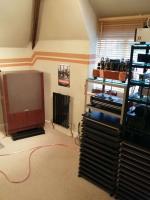
In terms of my own system and choice of components, as in all the best recipes (I see assembling a musically satisfying hi-fi system as essentially a 'recipe') I seek to bring out the most natural 'flavour' from the music. I feel it's no coincidence that the best systems I've heard mix and match old and new technologies, simply because neither single approach gets is absolutely right. Getting the most natural 'flavour' from music is thus best served by cherry-picking the highest quality vintage gear and mixing it with a soupçon of carefully selected modern kit to stand the best chance of obtaining this fundamental 'flavour'. This is not coloration: it's the difference between real and processed. When listening to music, I want to taste the 'real', richly flavoured, 'organic' apple - not the watery flavoured second-class citizen from the supermarket...
Marco.

 Reply With Quote

 Originally Posted by i_should_coco




 ), is 'Form' versus 'Function' as I term it.