

Mike, this has given me a few ideas, I'll PM you some thoughtsOriginally Posted by Mike_New

Cheers

 Trade: The Right One
Location: Far Away
Posts: 1,373
I'm Gone.

Mike, this has given me a few ideas, I'll PM you some thoughts
Cheers
 Senior Member
Location: Banbury, Oxfordshire/Panteg is where my late father was born
Posts: 4,381
I'm Chris.
Vantage audio claim a -2 DB improvement with a modified bearing , perhaps Noel Keywood could test it ? Any chance of this I wonder .
I think it it would be useful to know and put this to bed once and for all .
Chris
We've gone on holiday by mistake !

 Drunken Administrator

Location: Staffordshire, England
Posts: 43,351
I'm Martin.
Martin - no offence taken - There will be a number of factors that will effect the percentage of returns of any product that is not actually faulty. In this specific case, and as I understand it, until recently that would mean returning the bearing to Australia. In fact I'm not sure returns were an option at that point ( although I stand corrected if they were). In any case tweaking a hi-fi system is rarely straightforward. I can imagine many people fitting the bearing, listening over time and thinking that it was making some positive contribution in some areas. These things are rarely night and day. The general consensus is that the item does make an improvement so even if you can't hear it you may decide that it is due to issues elsewhere in your system, that, once sorted, will let the improvement show through. The price is at the level where the likely purchaser is going to have a fair amount of disposable income and quite possibly leads a very busy life - enough to add to the lethargy factor in terms of returns. 'I can't hear an improvement so I could send it back and get a refund but what the hell, it works fine and it's just too much bother.'
Current Lash Up:
TEAC VRDS 701T > Sony TAE1000ESD > Krell KSA50S > Troels Gravesen Faital 3WC-15.
 Senior Member
Location: Berkshire uk
Posts: 1,744
I'm Allthatwasisorwillbe.
In the case of the MNB against the stock,i would argue that there is a night and day difference,which is immediate and doesn't require lots of listening time! I was dubious about all the claims at first but having taken the plunge i can see it was wholly justified!
Whether the platters offer the same level of upgrade i don't know,so will be interesting hearing people's thoughts on that!
Darren
KORUS CUSTOM SERVER
TECHNICS 1200 MKII_JELCO 750D_SHURE SC35C (with NOS and NEO SAS styli)
CAIMAN SEG + DORADO PSU
CROFT MEGA MICRO
PARADIGM REFERENCE ACTIVE/40'S
PARADIGM SERVO 15 SUBWOOFER X 2
''The theory of relativity is a mass of error and deceptive ideas violently opposed to the teachings of great men of science of the past and even to common sense''
Banned
Location: Granes - Haut Vallee de l'aude - EU
Posts: 2,830
I'm Richard.
The problem is that's so hard to do. It is this issue of route to market and the decline of the hifi retailers I bought my gear from 30 years ago. I want to go into a shop and listen to the shortlist I'm Interested in. A few on here are priviliged to be able to borrow kit extensively. That is a tiny percentage of normal users. They need shops.
And measurements are both valuable in product development and "screening" for auditioning. I'll post those headphone measurements soon. Whilst measurements don't tell all they give some useful clues about whether that sound we like and choose is hi fidelity or hi likeability (coloured). The headphone tests made that point really well
 Senior Member
Location: A Strangely Isolated Place in Suffolk with Far Away Trains Passing By...
Posts: 14,540
I'm David.
Martin Colloms once did some turntable/platter/ mat tests once for 'Choice at the very least and the confirmation was definitely that what was right for one turntable (Dumpa style squidgey mat on a Thorens 160 for example) could be a disaster if the same mat was plonked on a different deck, such as an LP12 in this case, whereas a Linn felt mat to me sounded horrid on a GL75, which sounded far better with its own heavy ribbed one.
At the time (80's), the material as used in PT (and Void?) platters was judged to be the closest to properly optimising/terminating the vinyl when played as any material could get. I'm surprised that composite platters are now 'the thing,' unless it's for cost/machining reasons?
The thing is, any proper objective suggestions or methodology on such stuff has gone out of the window I reckon, so now, one man's huge improvement may actually be taking the sonics away from what is strictly the higher fidelity (to the source material) approach. Selling mail order and bake-offs is a fun thing for the hobbyist, but hardly takes the industry forward in my current opinion - and no, decent dealers like happy customers who DON'T keep coming back every few months for numerous dubious 'upgrades,' swinging with the tides. Rather, a good few clients who stay in touch occasionally over a twenty five or more year period for occasional major and thoughtful changes.
I can't go on and I can't go back, I don't feel so matter of fact,
I tried and tried to make good sense, What's the good to try it all again?
Trade: The Funk Firm
Posts: 72
I'm Arthur.
The measurement trap.
Recalling Pink Triangle introduced the world to the impedance match concept in the guise of the acrylic platter (obvious).
Martin Colloms then went forth, measured and produced results that showed a nicely damped response to a pulse.
What was not obvious was the actual effect that this transformation achieved. But it did sound "good".
If we look at FXR, measurements show a similar, order of magnitude improvement in the measurements.
Again, we extrapolate to a highly beneficial sonic experience.
But again, can we put our finger on just what we are going to experience? Not in the least. We only know we ought to be in for a treat.
Now, what about dynamic wow? The hypothesis seemed reasonable.
(Briefly: with 2g the minimum force required to keep the stylus in the groove at all times, track a 3kHz reference tone, apply a 2g load (a dustbug set to 2g!) and measure any drift)
Look! The results indeed showed problems and on that basis, deleterious conclusions were drawn on the outcome. (In the hysteria surrounding the LP12, the damage to Pink’s credibility cannot be overstated).
Only this time, there was no justification whatsoever. Although the full analysis is too long to provide here, try this gem:
In the publication, all turntables slowed (as they ought); all that is except DDs, which measured zero! Nil. Nix. Nada. I.e. Perfect. (Go dig out your original HiFi Choices)
What happened? Given the settling time, the servos had kicked in and pulled the platters up to speed. Moral: Measure at your peril!
Back to the thread: Having agreed that the original platter is indeed a weak link, we want to develop an improved one. But designers have their individual approaches.
One can indeed attempt to measure reflected energy but is that all there is to it? What about (as mentioned) the effect the servo has on the individual inertias?
Then we have the support quotient (for want of a label) to consider.
Here’s the problem: Regrettably, the ear, engineering solutions and measurements all travel along disparate paths, crossing fleetingly here and there.
Just look to cars and their setups when it comes to the driving experience. I like this car but you prefer that (and so just where does that leave the measurements?)
Similarly in our individual listening environments and systems, some will enhance and some will detract.
When developing a product, for what it’s worth, I bring to bear my 30 years experience into the design phase (creativity), develop interesting measurement methods - which I don’t always disclose (rigour) - and listen. Much tinkering and if I’m happy, the cake is baked. (The blend).
Ultimately you are left with cutting a slice, trying it when I hope you like it.
That’s subjectivism.
Senior Member
Location: Deleted
Posts: 6,566
I'm Deleted.
Voyd actually made two different 'plastic' platters. The cheaper was acrylic but they also made them from Lexan (polycarbonate).
Account Deleted
 Site Owner/Administrator
Location: Wrexham, North Wales, UK
Posts: 110,515
I'm AudioAl'sArbiterForPISHANTO.
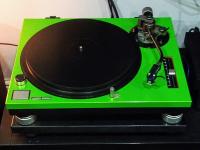
Indeed - again this is the reality. Subtle is not the level of sonic improvement noticed when one upgrades from the stock Technics bearing to an MN one. It is immediate and fundamental. For 'subtle', see the likes of upgrading the headshell on the stock tonearm for a Sumiko.
Marco.
Main System
Turntable: Heavily-modified Technics SL-1210MK5G [Mike New bearing/ETP platter/Paul Hynes SR7 PSU & regulator mods]. Funk Firm APM Achromat with Nagaoka GL-601 Crystal Record Weight. Isonoe feet & boots. Ortofon RS-212D tonearm with Denon DL-103GL, in a Denon PCL-300 headshell, fitted with Funk Firm Houdini and Kondo SL-115 pure-silver cartridge leads.
Paul Hynes MC head amp/SR5 PSU. Also modded Lentek head amp and Denon AU-310 SUT.
Other Cartridges: Nippon Columbia (NOS 1987) Denon DL-103. USA-made Shure SC35C with NOS stylus. Goldring G820 with NOS stylus. Shure M55E with NOS stylus.
CD Player: Audiocom-modified Sony X-777ES/DAS-R1 DAC.
Tape Deck: Tandberg TCD 310, fully restored and recalibrated as new by RDE, plus upgraded with heads from the TCD-420a. Also with matching TM4 Norway microphones.
Preamps: Heavily-modified Croft Charisma-X. Power Amps: Tube Distinctions Copper Amp, fitted with Tungsol KT-150s. Quad 306.
Cables & Sundries: Mark Grant HDX1 interconnects and digital coaxial cable, plus Mark Grant 6mm UP-LCOFC Van Damme speaker cable. MCRU 'Ultimate' mains leads. Lehmann clone headphone amp with vintage Koss PRO-4AAA headphones.
Tube Distinctions digital noise filter. VPI HW16.5 record cleaning machine.
Speakers: Tannoy 15MGs in Lockwood cabinets with modified crossovers. 1967 Celestion Ditton 15.
Banned
Location: Granes - Haut Vallee de l'aude - EU
Posts: 2,830
I'm Richard.
+1.
 Posting Permissions
 Reply With Quote