
Thankyou Andrew!Originally Posted by lewis

As it happens, I'm meeting with RFC's cabinet maker this morning to run through the designs and start making some trial versions. The final ones are a few weeks off and will be worth waiting for


 Trade: RFC
Location: Gloucestershire
Posts: 3,268
I'm Paul.

Thankyou Andrew!
As it happens, I'm meeting with RFC's cabinet maker this morning to run through the designs and start making some trial versions. The final ones are a few weeks off and will be worth waiting for
 Site Owner/Administrator
Location: Wrexham, North Wales, UK
Posts: 110,678
I'm AudioAl'sArbiterForPISHANTO.
Yes indeedy! Looking forward to seeing those
Regarding the Croft vs. Parasound thing, which Croft amps have you got Paul? IMO, the real gems in the Croft range are the preamps. The power amps are very good, but not quite in the same class as their (quite exceptional) preamps. I put this down to the power amps being a hybrid design, using MOSFETS with a valve input stage, rather than being out-and-out valve designs. That type of principle works very well in their preamps, but less so, IMO, with their power amps.
Quite simply, in order to compete with Jerry's Parasound 'muscle amp', in terms of transient response, dynamic impact and overall headroom, you need a big push-pull Class A valve amp, using the likes of KT88 or KT120 tubes and massive, top-notch, mains and output transformers, which combine to provide the required 'clout'!
In that respect, I think that the likes of my Tube Distinctions Copper amp would be more able to give the Parasound a run for its money, in terms of the things that 'big-boy' sand amps do best, as well as also throwing some thermionic lurveliness into the equation, for good measure! If I can make the bake-off at Martin T's this weekend (where Jerry's Parasound is going up against Martin's Chord behemoth), I'll get the opportunity to demonstrate this, if I bring the Copper amp down with me
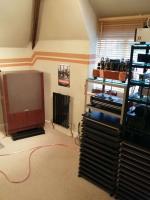
A couple of pics of the beastie in question... In situ in my listening room:
The last time Martin heard it in his system, along with my (heavily modified) Croft preamp:
Since then it's had a bigger mains transformer fitted, from Sowter, been upgraded from 30W to 50WPC Class A, had Clarity Cap MR power supply caps fitted, KT88s changed to KT120s and GZ34 rectifiers changed to 5U4GBs, new NOS Brimar CV1988 driver valves, Cardas solid-copper speaker terminals, Furutech phonos and IEC socket fitted, along with dual-mono variable feedback control.
Yes, it's even better now than it was before....!
Marco.
Main System
Turntable: Heavily-modified Technics SL-1210MK5G [Mike New bearing/ETP platter/Paul Hynes SR7 PSU & regulator mods]. Funk Firm APM Achromat with Nagaoka GL-601 Crystal Record Weight. Isonoe feet & boots. Ortofon RS-212D tonearm with Denon DL-103GL, in a Denon PCL-300 headshell, fitted with Funk Firm Houdini and Kondo SL-115 pure-silver cartridge leads.
Paul Hynes MC head amp/SR5 PSU. Also modded Lentek head amp and Denon AU-310 SUT.
Other Cartridges: Nippon Columbia (NOS 1987) Denon DL-103. USA-made Shure SC35C with NOS stylus. Goldring G820 with NOS stylus. Shure M55E with NOS stylus.
CD Player: Audiocom-modified Sony X-777ES/DAS-R1 DAC.
Tape Deck: Tandberg TCD 310, fully restored and recalibrated as new by RDE, plus upgraded with heads from the TCD-420a. Also with matching TM4 Norway microphones.
Preamps: Heavily-modified Croft Charisma-X. Power Amps: Tube Distinctions Copper Amp, fitted with Tungsol KT-150s. Quad 306.
Cables & Sundries: Mark Grant HDX1 interconnects and digital coaxial cable, plus Mark Grant 6mm UP-LCOFC Van Damme speaker cable. MCRU 'Ultimate' mains leads. Lehmann clone headphone amp with vintage Koss PRO-4AAA headphones.
Tube Distinctions digital noise filter. VPI HW16.5 record cleaning machine.
Speakers: Tannoy 15MGs in Lockwood cabinets with modified crossovers. 1967 Celestion Ditton 15.
Trade: RFC
Location: Gloucestershire
Posts: 3,268
I'm Paul.
I'm using the Croft Micro25 pre with the Series 7R power amp Marco. I agree with you. the Micro25, even though not the "full blown" version is about as good a pre as I've ever heard. I have tried valve rolling with it (NOS of course) but TBH there's very litle difference between any ECC83 put in it and the system is revealing enough to distinguish differences. This accords with Glenns' views I think so is a circuit design thing.
The power is very good and punchy, but lacks ultimate precision IMHO. Thats a compliment by the way as for the money, there's not a lot out there to touch the 7R.
My own preference if using all valve would be pure class A for lower distortion. The valve type may impact output but sound is something determined more by the circut design and quality of power supplies and output transformers. Big money for something really good though compared with a good SS. However, in SS format, and for the money, I still rate the Quad 909 as one of the best in class having tried one with a range of pre-amps and speakers. It was remarkably close to the Parasound. Consummate ease of power deliver with bags in reserve, very polished detail and high definition of things like the leading edge of bass notes and very high S/N for low noisefloor. Also vanishingly low distortion across the frequency band.
The Tannoys are on order and will be with me in 4 to 5 weeks. At present they are probably still in timber sheets waiting to be cut and the electronics in bits in boxes somewhere! I can see the elderly gents wearing half moon glasses and spotless blue aprons with a flat pencil behind their ears approaching the timber stacks right now...
Senior Member

Location: gone
Posts: 11,510
I'm gone.
To be fair to the Croft power amp, my Parasound is the best sounding amp I've come across in all my years of boxswapping and dozens and dozens of fine amps of all types have been heard.
It's not just about power and headroom, though, even on very low level music where just a watt or two is required the Parasound still excels, imho.
I meet up this Saturday at MartinT's place to see how the big Para does with his Ushers. Mucho looking forward to that.
.
Site Owner/Administrator
Location: Wrexham, North Wales, UK
Posts: 110,678
I'm AudioAl'sArbiterForPISHANTO.
Hi Paul,
I completely agree. Good circuit design is far more influential and important than the effects of tube-rolling. In comparison, swapping valves can only ever cause subtle changes, usually in terms of tonality, although some also allow an amp to deliver greater punch and drive.I'm using the Croft Micro25 pre with the Series 7R power amp Marco. I agree with you. the Micro25, even though not the "full blown" version is about as good a pre as I've ever heard. I have tried valve rolling with it (NOS of course) but TBH there's very litle difference between any ECC83 put in it and the system is revealing enough to distinguish differences. This accords with Glenns' views I think so is a circuit design thing.
However, the effects of tube-rolling are rather more obvious in Croft's earlier high-end preamps, such as the Charisma X, which I use, that feature the bigger octal 6SL7 type valves. These are a different ball-game to ECC83s, and have a much bigger, richer, more 'finessed' sound. Playing around with different types of those has a rather more profound effect on the sound.
A sneaky peak inside my preamp, showing various NOS 1940s and 1950s-vintage 6SL7s, at the back, and the (superb, best I've heard) SCR Teflon Foil coupling capacitors (shown in green) at the front:
Again, I totally agree. For me, Class A (when done *really* well) is where its at, no matter whether we're talking about SS or valve amps, as the way in which it reproduces music is truly magical!My own preference if using all valve would be pure class A for lower distortion. The valve type may impact output but sound is something determined more by the circut design and quality of power supplies and output transformers. Big money for something really good though compared with a good SS.
Big money? Yes, but perhaps not as much as you might think... The Copper amp (hand-built and hard-wired from scratch, featuring hand-wound transformers and the highest quality components) does all that, and it can be bought brand new for £5k
Inside the beastie:
You should really come up sometime and have a listen!
Marco.
Main System
Turntable: Heavily-modified Technics SL-1210MK5G [Mike New bearing/ETP platter/Paul Hynes SR7 PSU & regulator mods]. Funk Firm APM Achromat with Nagaoka GL-601 Crystal Record Weight. Isonoe feet & boots. Ortofon RS-212D tonearm with Denon DL-103GL, in a Denon PCL-300 headshell, fitted with Funk Firm Houdini and Kondo SL-115 pure-silver cartridge leads.
Paul Hynes MC head amp/SR5 PSU. Also modded Lentek head amp and Denon AU-310 SUT.
Other Cartridges: Nippon Columbia (NOS 1987) Denon DL-103. USA-made Shure SC35C with NOS stylus. Goldring G820 with NOS stylus. Shure M55E with NOS stylus.
CD Player: Audiocom-modified Sony X-777ES/DAS-R1 DAC.
Tape Deck: Tandberg TCD 310, fully restored and recalibrated as new by RDE, plus upgraded with heads from the TCD-420a. Also with matching TM4 Norway microphones.
Preamps: Heavily-modified Croft Charisma-X. Power Amps: Tube Distinctions Copper Amp, fitted with Tungsol KT-150s. Quad 306.
Cables & Sundries: Mark Grant HDX1 interconnects and digital coaxial cable, plus Mark Grant 6mm UP-LCOFC Van Damme speaker cable. MCRU 'Ultimate' mains leads. Lehmann clone headphone amp with vintage Koss PRO-4AAA headphones.
Tube Distinctions digital noise filter. VPI HW16.5 record cleaning machine.
Speakers: Tannoy 15MGs in Lockwood cabinets with modified crossovers. 1967 Celestion Ditton 15.
Trade: RFC
Location: Gloucestershire
Posts: 3,268
I'm Paul.
Out of my price range. I'd probably go for a big class A SS power amp at a quarter of the price ;-)
Site Owner/Administrator
Location: Wrexham, North Wales, UK
Posts: 110,678
I'm AudioAl'sArbiterForPISHANTO.
Lol - if I was going SS, I'd probably have the Usher Reference R-1.5:

Deco Audio are selling it for £1500: http://www.decoaudio.com/deco_audio_...mplifiers.html
I've heard the beastie, and it's stunning!
Marco.
Main System
Turntable: Heavily-modified Technics SL-1210MK5G [Mike New bearing/ETP platter/Paul Hynes SR7 PSU & regulator mods]. Funk Firm APM Achromat with Nagaoka GL-601 Crystal Record Weight. Isonoe feet & boots. Ortofon RS-212D tonearm with Denon DL-103GL, in a Denon PCL-300 headshell, fitted with Funk Firm Houdini and Kondo SL-115 pure-silver cartridge leads.
Paul Hynes MC head amp/SR5 PSU. Also modded Lentek head amp and Denon AU-310 SUT.
Other Cartridges: Nippon Columbia (NOS 1987) Denon DL-103. USA-made Shure SC35C with NOS stylus. Goldring G820 with NOS stylus. Shure M55E with NOS stylus.
CD Player: Audiocom-modified Sony X-777ES/DAS-R1 DAC.
Tape Deck: Tandberg TCD 310, fully restored and recalibrated as new by RDE, plus upgraded with heads from the TCD-420a. Also with matching TM4 Norway microphones.
Preamps: Heavily-modified Croft Charisma-X. Power Amps: Tube Distinctions Copper Amp, fitted with Tungsol KT-150s. Quad 306.
Cables & Sundries: Mark Grant HDX1 interconnects and digital coaxial cable, plus Mark Grant 6mm UP-LCOFC Van Damme speaker cable. MCRU 'Ultimate' mains leads. Lehmann clone headphone amp with vintage Koss PRO-4AAA headphones.
Tube Distinctions digital noise filter. VPI HW16.5 record cleaning machine.
Speakers: Tannoy 15MGs in Lockwood cabinets with modified crossovers. 1967 Celestion Ditton 15.
Trade: RFC
Location: Gloucestershire
Posts: 3,268
I'm Paul.
To do it properly, it needs to be a PROPER Class A, a stonking big SET, something like the big ol' 211's, no push-pull. Very dynamic sounding, great headroom. Had a few push-pull valve amps including a Lumley ST40 and a Consonance Cyber 10s which claimed to be Class A, but they were only Class A for the first Watt or so before the circuit behaved (push-pull) class AB. Whatever, they sounded good. Less interested in the circuit design (I'll leave that to those who design the things) and more interested in what they sound like.
Jerry's Parasound Halo is one of the best power amps I've come across in the sonic stakes. Neutral, massive headroom and portrays micro detail like few others.
The Quad 909 I particularly liked, despite its dissenters. Not unlike the Parasound in character but from what I can remember, more "3-D" in presentation. Not ultimately as detailed but close.
The Lumley ST40 was the very best of the valve amps I had and one of the best amps I've owned. No relation of the St70, a far better circuit design, tweaked by Ben Carter for John Jefferies who owned the Lumley Brand. It brought music alive in my system. Sold it to help pay some stock bills (even though it was one of only 10 ever built in the better mk1 guise). We all do silly things.
The Croft pre I'd describe as outstanding at the price point and would recommend it to anyone without hesitation (25R even better I'm told). The Series 7R is ok and reasonable value. It does punch above its rated output and is relatively polished (refined...low distortion, good S/N and channel separation and gives music a nice depth) but there are more refined power amps out there and you do need to be careful not to switch inputs on the pre without turning the volume (controls) down to avoid popping fuses all the time in the power amp.
Site Owner/Administrator
Location: Wrexham, North Wales, UK
Posts: 110,678
I'm AudioAl'sArbiterForPISHANTO.
Hi Paul,
I know what you mean, but you *can* have proper Class A, with a P/P amp. I've heard big 211 SET amps, and whilst they're very good, I still wouldn't swap them for my copper amp, which is also a true Pure Class A design. Read here, for more on the design of the Copper amp: http://www.tubedistinctions.co.uk/custom.htmTo do it properly, it needs to be a PROPER Class A, a stonking big SET, something like the big ol' 211's, no push-pull.
Have a read at this article too, which explains some of the common misconceptions you've alluded to: http://www.aikenamps.com/ClassA.htm
...noting this bit in particular:
A class A audio amplifier can be either single-ended or push-pull. Now, you might be thinking, how can a push-pull amplifier be class A? Doesn't one side amplify half the waveform and the other side amplify the other half? Isn't this why we use a phase splitter?
These are common misconceptions. You can, indeed have a true class A amplifier that operates in push-pull mode. Amplifier class has absolutely nothing to do with output stage topology. If the output tubes on either side of a push-pull pair are biased in class A (halfway between cutoff and saturation), then the current in each side will still flow for the full 360 degrees of the input cycle, just in opposing directions. As one tube's current increases from the midpoint, or idle, bias current, the other tube's current is decreasing by an equal amount.
The output transformer sums these oppositely-phased currents to produce the output waveform in the secondary winding. As one side reaches saturation, the other side reaches cutoff, just as they would in a single-ended class A amplifier. Neither side cuts off at the full, unclipped output power of the amplifier. The output power of a push-pull class A amplifier is exactly twice the output power of a single-ended class A amplifier operating under the same conditions of plate voltage, bias, and effective load impedance.
Marco.
Main System
Turntable: Heavily-modified Technics SL-1210MK5G [Mike New bearing/ETP platter/Paul Hynes SR7 PSU & regulator mods]. Funk Firm APM Achromat with Nagaoka GL-601 Crystal Record Weight. Isonoe feet & boots. Ortofon RS-212D tonearm with Denon DL-103GL, in a Denon PCL-300 headshell, fitted with Funk Firm Houdini and Kondo SL-115 pure-silver cartridge leads.
Paul Hynes MC head amp/SR5 PSU. Also modded Lentek head amp and Denon AU-310 SUT.
Other Cartridges: Nippon Columbia (NOS 1987) Denon DL-103. USA-made Shure SC35C with NOS stylus. Goldring G820 with NOS stylus. Shure M55E with NOS stylus.
CD Player: Audiocom-modified Sony X-777ES/DAS-R1 DAC.
Tape Deck: Tandberg TCD 310, fully restored and recalibrated as new by RDE, plus upgraded with heads from the TCD-420a. Also with matching TM4 Norway microphones.
Preamps: Heavily-modified Croft Charisma-X. Power Amps: Tube Distinctions Copper Amp, fitted with Tungsol KT-150s. Quad 306.
Cables & Sundries: Mark Grant HDX1 interconnects and digital coaxial cable, plus Mark Grant 6mm UP-LCOFC Van Damme speaker cable. MCRU 'Ultimate' mains leads. Lehmann clone headphone amp with vintage Koss PRO-4AAA headphones.
Tube Distinctions digital noise filter. VPI HW16.5 record cleaning machine.
Speakers: Tannoy 15MGs in Lockwood cabinets with modified crossovers. 1967 Celestion Ditton 15.
Trade: RFC
Location: Gloucestershire
Posts: 3,268
I'm Paul.
I know what you mean Marco and was just being provocativeand purist about Class A (I do understand each of the topologies). I have owned and heard both but the sweetest was single ended. Best I heard was a Horning Sati 520 SET. 12w of SET gloriousness.
 Posting Permissions

 Reply With Quote


