+ Reply to Thread
Page 1 of 2 12 LastLast
Results 1 to 10 of 11

Thread: Interesting article: R&D Stories: The Role of Resonance in Audio Clarity

  1. #1
    Join Date: Oct 2008

    Location: Glasgowshire

    Posts: 10,655
    I'm Gary.

    Default Interesting article: R&D Stories: The Role of Resonance in Audio Clarity

    DIY mods to your gear - damping Capacitors inside your equipment?
    Been doing it for years here, improved the sound.

    Basically,
    if your of the DIY/ improve your Gear mindset... put a blob of damping compound (Dynamat, SilentCoat etc) on your Caps.

    Turns out ClarityCap and the Institute of Acoustics at the University of Salford did a two year research study on it too?

    https://audioxpress.com/article/r-d-...-audio-clarity

    Gets a bit deep into the weeds of it,
    But should satisfy the ASR crowd?

  2. #2
    Join Date: Aug 2009

    Location: Staffordshire, England

    Posts: 43,780
    I'm Martin.

    Default

    The resonance is very tiny and starts higher in frequency than I can hear.

    Note they open with 'The mean amplitude varied depending on which capacitor was being tested and, for most capacitors, the emissions were clearly audible'.

    Then later row back to


    'The difference in sound produced by two different metallized film capacitors in the high-frequency driver circuit of a first-order crossover is very slight. It is possible that this difference could only be detected by a listener trained to critically evaluate and develop audio systems.'


    Most speakers don't use a first order crossover, most that do aren't very good to begin with.

    Also since this is an electrical resonance I'm not sure that using damping compound would actually prevent it occurring? Maybe it would. It's interesting, I agree.
    Current Lash Up:

    TEAC VRDS 701T > Sony TAE1000ESD > Krell KSA50S > Troels Gravesen Faital 3WC-15.

  3. #3
    Join Date: Jan 2009

    Location: Essex

    Posts: 38,289
    I'm openingabottleofwine.

    Default

    Thus is a typical piece of promotional literature from an audio component supplier. It looks impressive but would be rejected by any audio electronics or electrical engineering journal for its complete absence of reference levels shown in the graphs. For example in Figure 1, nowhere does it state what 0dB corresponds to in absolute level. Likewise in the later three-axis graphs, nowhere does it state what "parameter 1" and what "parameter 2" are.

    Being generous all that can be said of this work is that some electrical resonance created by mechanical effects can be reduced in the audio spectrum, but as there no quantification of the achieved improvement, it is hard to believe how audible the improvements are. The only figure quoted is 4.3dB; an improvement from say -10dBm to -14.3dBm might certainly be noticeable, but a change from -30dBm to -34.3dBm would not.

    Again this is not to say that additional external treatment to dampen mechanical vibration can not be successful, but IMHO it is a case of post hoc, ergo propter hoc by believers. If you want to cover all the capacitors with silicone bath sealant or Blu Tack then you can; it certainly won't make the situation worse.
    Barry

  4. #4
    Join Date: Jan 2008

    Location: Wrexham, North Wales, UK

    Posts: 111,234
    I'm AudioAl'sArbiterForPISHANTO.

    Default

    Quote Originally Posted by Gazjam View Post
    DIY mods to your gear - damping Capacitors inside your equipment?
    Been doing it for years here, improved the sound.
    Same here! My 1987 vintage Sony DAC has damping compound around the PSU caps, so if a company like Sony are doing that then you'd think there's something in it.

    After a lengthy capacitor comparison test, with a few friends, I selected ClarityCap MR caps for the crossovers in my Tannoys, as they sounded the best

    Marco.
    Main System

    Turntable: Heavily-modified Technics SL-1210MK5G [Mike New bearing/ETP platter/Paul Hynes SR7 PSU & regulator mods]. Funk Firm APM Achromat with Nagaoka GL-601 Crystal Record Weight. Isonoe feet & boots. Ortofon RS-212D tonearm with Denon DL-103GL in a Denon PCL-300 headshell, fitted with Funk Firm Houdini and Kondo SL-115 pure-silver cartridge leads.

    Paul Hynes MC head amp/SR5 PSU. Also modded Lentek head amp and Denon AU-310 SUT.

    Other Cartridges: Nippon Columbia (NOS 1987) Denon DL-103. USA-made Shure SC35C with NOS stylus. Goldring G820 with NOS stylus. Shure M55E with NOS stylus.

    CD Player: Audiocom-modified Sony X-777ES/DAS-R1 DAC.

    Tape Deck: Tandberg TCD 310, fully restored and recalibrated as new by RDE, plus upgraded with heads from the TCD-420a. Also with matching TM4 Norway microphones.

    Preamps: Heavily-modified Croft Charisma-X. Power Amps: Tube Distinctions Copper Amp, fitted with Tungsol KT-150s. Quad 306.

    Cables & Sundries: Mark Grant HDX1 interconnects and digital coaxial cable, plus Mark Grant 6mm UP-LCOFC Van Damme speaker cable. MCRU 'Ultimate' mains leads. Lehmann clone headphone amp with vintage Koss PRO-4AAA headphones.

    Tube Distinctions digital noise filter. VPI HW16.5 record cleaning machine.

    Speakers: Tannoy 15MGs in Lockwood cabinets with modified crossovers. 1967 Celestion Ditton 15.

  5. #5
    Join Date: Jan 2009

    Location: Essex

    Posts: 38,289
    I'm openingabottleofwine.

    Default

    Quote Originally Posted by Marco View Post
    Same here! My 1987 vintage Sony DAC has damping compound around the PSU caps, so if a company like Sony are doing that then you'd think there's something in it.


    Marco.
    You may like to think so, but you would be surprised how many 'tweaks' audio equipment manufacturers will make because they know it is expected by their potential customers. Witness the provision by speaker manufacturers for bi-wiring (or tri-wiring) their designs.

    In the case of your Sony the tweak is internal, which lends itself to the idea that Sony thought it was necessary for the same reasons Clarity Caps suggest - yet when audio electronics are reviewed now, their construction both internal and external is examined by reviewers who think these details important, if not essential.

    I remain sceptical in the case of electronics, but believe it is possibly more important in speakers given the greatly increased level of internal vibration the crossover components can suffer.
    Barry

  6. #6
    Join Date: Jan 2008

    Location: Wrexham, North Wales, UK

    Posts: 111,234
    I'm AudioAl'sArbiterForPISHANTO.

    Default

    It's interesting though that Sony thought of this way back in 1987 - long before such tweaks were considered as important in the wider domain. You're right to be sceptical, but I think there's something in it, certainly as you say, when it comes to loudspeakers, where there exists more vibration.

    Certainly, to my ears, there was a marked improvement with the ClarityCap MRs compared with the other capacitors under test - and it wasn't subtle!

    Marco.
    Main System

    Turntable: Heavily-modified Technics SL-1210MK5G [Mike New bearing/ETP platter/Paul Hynes SR7 PSU & regulator mods]. Funk Firm APM Achromat with Nagaoka GL-601 Crystal Record Weight. Isonoe feet & boots. Ortofon RS-212D tonearm with Denon DL-103GL in a Denon PCL-300 headshell, fitted with Funk Firm Houdini and Kondo SL-115 pure-silver cartridge leads.

    Paul Hynes MC head amp/SR5 PSU. Also modded Lentek head amp and Denon AU-310 SUT.

    Other Cartridges: Nippon Columbia (NOS 1987) Denon DL-103. USA-made Shure SC35C with NOS stylus. Goldring G820 with NOS stylus. Shure M55E with NOS stylus.

    CD Player: Audiocom-modified Sony X-777ES/DAS-R1 DAC.

    Tape Deck: Tandberg TCD 310, fully restored and recalibrated as new by RDE, plus upgraded with heads from the TCD-420a. Also with matching TM4 Norway microphones.

    Preamps: Heavily-modified Croft Charisma-X. Power Amps: Tube Distinctions Copper Amp, fitted with Tungsol KT-150s. Quad 306.

    Cables & Sundries: Mark Grant HDX1 interconnects and digital coaxial cable, plus Mark Grant 6mm UP-LCOFC Van Damme speaker cable. MCRU 'Ultimate' mains leads. Lehmann clone headphone amp with vintage Koss PRO-4AAA headphones.

    Tube Distinctions digital noise filter. VPI HW16.5 record cleaning machine.

    Speakers: Tannoy 15MGs in Lockwood cabinets with modified crossovers. 1967 Celestion Ditton 15.

  7. #7
    Join Date: Jun 2008

    Location: Wirral

    Posts: 745
    I'm duncan.

    Default

    sony dac


    I often wonder about active speakers with internal amps inside, the vibrations etc...

  8. #8
    Join Date: Jan 2008

    Location: Wrexham, North Wales, UK

    Posts: 111,234
    I'm AudioAl'sArbiterForPISHANTO.

    Default

    That's exactly what I've got around the caps in mine, Dunc. Which model is that you've got?

    Marco.
    Main System

    Turntable: Heavily-modified Technics SL-1210MK5G [Mike New bearing/ETP platter/Paul Hynes SR7 PSU & regulator mods]. Funk Firm APM Achromat with Nagaoka GL-601 Crystal Record Weight. Isonoe feet & boots. Ortofon RS-212D tonearm with Denon DL-103GL in a Denon PCL-300 headshell, fitted with Funk Firm Houdini and Kondo SL-115 pure-silver cartridge leads.

    Paul Hynes MC head amp/SR5 PSU. Also modded Lentek head amp and Denon AU-310 SUT.

    Other Cartridges: Nippon Columbia (NOS 1987) Denon DL-103. USA-made Shure SC35C with NOS stylus. Goldring G820 with NOS stylus. Shure M55E with NOS stylus.

    CD Player: Audiocom-modified Sony X-777ES/DAS-R1 DAC.

    Tape Deck: Tandberg TCD 310, fully restored and recalibrated as new by RDE, plus upgraded with heads from the TCD-420a. Also with matching TM4 Norway microphones.

    Preamps: Heavily-modified Croft Charisma-X. Power Amps: Tube Distinctions Copper Amp, fitted with Tungsol KT-150s. Quad 306.

    Cables & Sundries: Mark Grant HDX1 interconnects and digital coaxial cable, plus Mark Grant 6mm UP-LCOFC Van Damme speaker cable. MCRU 'Ultimate' mains leads. Lehmann clone headphone amp with vintage Koss PRO-4AAA headphones.

    Tube Distinctions digital noise filter. VPI HW16.5 record cleaning machine.

    Speakers: Tannoy 15MGs in Lockwood cabinets with modified crossovers. 1967 Celestion Ditton 15.

  9. #9
    Join Date: Jan 2009

    Location: Essex

    Posts: 38,289
    I'm openingabottleofwine.

    Default

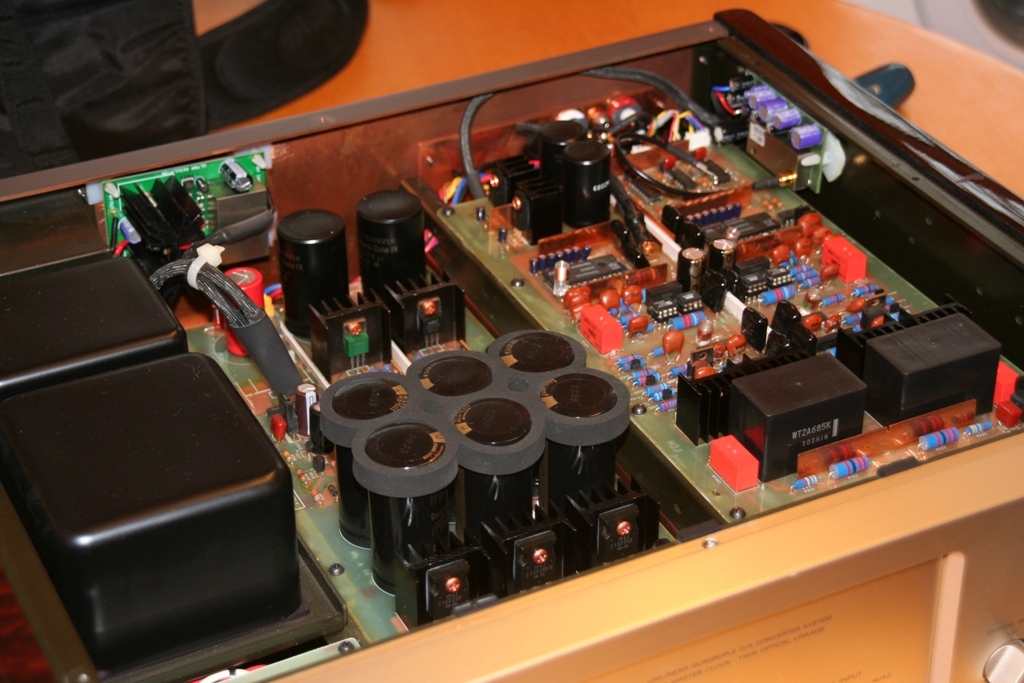
    That is a very helpful image which prompts several reasons why Sony would have fitted a compliant rubber (?) gasket around the six electrolytic capacitors of the power supply.

    The first to note is that the 'damping' material is only applied to the upper end of the capacitors, not to the entire surface, which is what Clarity would recommend. Also damping material is only applied to these six capacitors and to no others.

    My suggestion would be that the electrolytics being tall and heavy, could resonate as a whole when exposed to internal transformer hum. It is not clear from the photo what kind of transformer is used, but if one using E-I laminations, or a bi-limboid design, these can vibrate slightly compared to toroidal designs which are much better in that respect. The height of the transformer casing suggest that a toroidal transformer is not used. Thus the rubber gasket was fitted to absorb this vibrational kinetic energy.

    Electrolytic capacitors are the heaviest components of the power supply mounted on the PCB. Connecting them together with the gasket braces them against movement, and so protect the copper traces and solder joints from cracking during shipping and handling.

    The gasket also helps keep the capacitors away from the heat-generating voltage regulators that are in close proximity to them. There are three voltage regulators fitted to individual heatsinks on each side of the group of capacitors.

    So, again IMHO, this is good mechanical construction design, rather than damping of any internal resonance within the electrolytic capacitors.
    Barry

  10. #10
    Join Date: Jan 2008

    Location: Wrexham, North Wales, UK

    Posts: 111,234
    I'm AudioAl'sArbiterForPISHANTO.

    Default

    Good input, Barry. I think what you're saying is most likely true, and of course a by-product of that could be the damping of internal residence within the caps themselves, which I do believe is a separate issue - therefore a two for one tweak from the masters of Sony!

    Marco.
    Main System

    Turntable: Heavily-modified Technics SL-1210MK5G [Mike New bearing/ETP platter/Paul Hynes SR7 PSU & regulator mods]. Funk Firm APM Achromat with Nagaoka GL-601 Crystal Record Weight. Isonoe feet & boots. Ortofon RS-212D tonearm with Denon DL-103GL in a Denon PCL-300 headshell, fitted with Funk Firm Houdini and Kondo SL-115 pure-silver cartridge leads.

    Paul Hynes MC head amp/SR5 PSU. Also modded Lentek head amp and Denon AU-310 SUT.

    Other Cartridges: Nippon Columbia (NOS 1987) Denon DL-103. USA-made Shure SC35C with NOS stylus. Goldring G820 with NOS stylus. Shure M55E with NOS stylus.

    CD Player: Audiocom-modified Sony X-777ES/DAS-R1 DAC.

    Tape Deck: Tandberg TCD 310, fully restored and recalibrated as new by RDE, plus upgraded with heads from the TCD-420a. Also with matching TM4 Norway microphones.

    Preamps: Heavily-modified Croft Charisma-X. Power Amps: Tube Distinctions Copper Amp, fitted with Tungsol KT-150s. Quad 306.

    Cables & Sundries: Mark Grant HDX1 interconnects and digital coaxial cable, plus Mark Grant 6mm UP-LCOFC Van Damme speaker cable. MCRU 'Ultimate' mains leads. Lehmann clone headphone amp with vintage Koss PRO-4AAA headphones.

    Tube Distinctions digital noise filter. VPI HW16.5 record cleaning machine.

    Speakers: Tannoy 15MGs in Lockwood cabinets with modified crossovers. 1967 Celestion Ditton 15.

+ Reply to Thread
Page 1 of 2 12 LastLast

Posting Permissions

  • You may not post new threads
  • You may not post replies
  • You may not post attachments
  • You may not edit your posts
  •