
Closed Thread
Page 17 of 35 FirstFirst ... 7151617181927 ... LastLast
Results 161 to 170 of 347

Thread: Why do you need a speaker crossover - discuss

  1. #161
    Join Date: Aug 2008

    Location: London

    Posts: 2,410
    I'm Nat-andthat'swhyIdrink.

    Default

    Quote Originally Posted by pure sound View Post
    You can look at it the other way round. Someone might feel that a carefully implemented crossover or a well designed output transformer (for example) were tools that might be used to take advantage of the particular attributes of a drive unit or a particular output device like a Direct Heated Triode and without them the benefits of those items might not be realised.

    With regard to horns, you wouldn't dope the horn. You'd hope that it was fairly inert though. However it will still have a driver behind it and that might benefit from mechanical treatment in just the same way as it might in a conventional direct radiator. Indeed the profile of the horn chosen might be used to extend or limit the bandwidth or sensitivity of a particular driver by strictly mechanical means!

    With drivers dozens of different cone materials and profiles have been tried. Trying to control cone behaviour & break-up invariably seems to involve adding mass in one way or another. ie heavier, stiffer materials, ribs, doping etc. These treatments certainly will alter the sound just as applying correction via electrical means will. I still keep going back to paper cones which, when they do misbehave, do so in what seems a predictable & natural way. Adding mass will compromise the fineness of their resolving power though.

    I suppose the reason I like multi-way horns is that when used with drivers having lightweight diaphragms & powerful magnets, they can produce adequate SPLs with the minimum of cone movement so a reduced chance of distortion through diaphragm deformation or through the voice coil having to move in the less linear parts of the magnet gap.

    With regard to the directly driven electrostatics, its an intriguing idea & I'd like to hear them if only to learn whether it addresses my reservations about electrostatic loudspeakers. Having seen some of Nick's other work (well pictures of it) I'm sure he's more than capable of implementing it safely. I'm not sure it'd ever be a commercial product but then people do make plasma tweeters so who knows?

    EDIT. I did once hear some Beveridge System 2's which had 200W valve amps built into the bases and which may have been directly coupled. They were by far the most impressive electrostatic speakers I've heard, not without flaws but head & shoulders clear of the usual Quads & Martin Logans.
    Quote Originally Posted by Dr Bunsen Honeydew View Post
    Then they are necessary, that is not the point of this thread. They will become unnecessary when an individual finds a way to do without them. In that case would you hang on to them just for the sake of it.

    The rest of your post I agree with.


    That was my question earlier.

  2. #162
    Join Date: Aug 2008

    Location: London

    Posts: 2,410
    I'm Nat-andthat'swhyIdrink.

    Default

    Quote Originally Posted by Dr Bunsen Honeydew View Post
    Ah the $64k question. I can only give my opinion. A crossover is the seperation of two drivers, protection and sensitivty matching is not, it is just (normally) on the tweeter. So if there are no components associated with the other driver(s) it is not a crossover.

    Even if it is just a coil (inductor) on the bass / mid then it becomes a simple crossover (as use by Royd for example) more elements to create steeper filter slopes and elements to tailor the response in band turns it complicated and complex and problematic.
    Oddly enough, the designer of my Jordan JX92 drivered speakers added an inductor (can't remember his reason) after extensive listening tests - might see what happens when I remove it from the equation.

  3. #163
    Join Date: Oct 2008

    Location: Scotland

    Posts: 316
    I'm Paul.

    Default

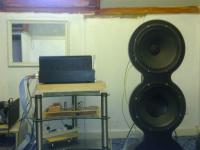
    You could argue that my open baffle line source arrays use mechanical solutions for tricky issues. I use Visaton B200 drivers and their individual response curve is anything but flat through the audio band, although I suspect these curves were produced from drive units that were fresh off the production line and not run in. After a month or so of run in the ragged top end smoothes out considerably and the drive unit sounds more coherent through the audio band. The bass end of an individual drive unit is lightweight due to the falling response, but happily, when mounting eight drive units in a vertical array, the parallel operation of the drive units gives a large boost in efficiency in the lower mid and bass end, which reinforces the bass very nicely in a way that evens out the bass/mid response to the point where I do not feel the need for subwoofers. The bass goes very deep when there is deep bass in the program and there is no cabinet honk or restriction as the arrays are open baffle. A well recorded kick drum sounds like a kick drum and I should know what this sounds like as I usually stood near to the drummer in the group I used to play in as a youngster.

    Line arrays have benefits regarding reduced room interaction due to the way they propagate energy into the room. This is another mechanical solution to reduce an age-old problem of room interaction.

    I have to admit that the top end rolls off a little earlier than many would require, however this can be a blessing with some program especially from digital sources, and the treble is nicely coherent.

    The near field amplitude response of the line array falls off at only 3 dB for every doubling of distance whereas a point source propagating a spherical wave front falls off at 6 dB per doubling of distance. This adds further to the overall efficiency in a beneficial way. The very high efficiency of the lines means I only need a few watts to achieve concert levels, which is a nice side effect of the parallel drive units and the effects of the way the wave front is propagated into the room, which is once again a result of a mechanical solution.

    Using eight drivers per channel means the lines can move enough air for concert levels without extreme cone excursions so the distortion levels of the drive units are very low.

    So effectively I have moved away from complexity by implementing mechanical solutions in the loudspeaker design to minimise components in the signal path. There are no crossover components in the arrays. This has benefited the electronics too and my power amp has one mosfet and one resistor in the direct signal path and my line preamp is an LDR L-pad with one LDR directly in series with the signal. There is just no need for any voltage gain in these sections.

    This works for me and I have not felt the need to work on the speakers or amplification for over four years. Prior to that I was always fiddling around spending vast amounts of R&D time looking for improvements.

    Out of interest the system is great for home cinema duty too and some of the sound effects in the blockbuster films can be awesome.

    Paul
    Paul Hynes Design
    paulhynesdesign.com
    High Performance Power Supply upgrades
    http://theartofsound.net/forum/showthread.php?t=16655
  4. #164
    Join Date: May 2008

    Location: Cricklewood

    Posts: 9,074
    I'm ILOB.

    Default

    A very interesting approach Paul. I am wondering if possible you can show some pictures perhaps on another thread I for one would find it very interesting
    Loves anything from Pain of Salvation to Jeff Buckley to Django to Sarasate to Surinder Sandhu to Shawn Lane to Nick Drake to Rush to Beth Hart to Kate Bush to Rodrigo Y Gabriela to The Hellecasters to Dark Sanctury to Ben Harper to Karicus to Dream Theater to Zero Hour to Al DiMeola to Larry Carlton to Derek Trucks to Govt Mule to?

    Humour: One of the few things worth taking seriously

  5. #165
    Join Date: Aug 2009

    Location: Staffordshire, England

    Posts: 43,613
    I'm Martin.

    Default

    Yes a picture would be good if possible, please Paul?
    Current Lash Up:

    TEAC VRDS 701T > Sony TAE1000ESD > Krell KSA50S > Troels Gravesen Faital 3WC-15.

  6. #166
    Join Date: Mar 2009

    Location: Glastonbury, UK

    Posts: 1,118
    I'm Chris.

    Default

    Quote Originally Posted by Paul Hynes View Post
    ...happily, when mounting eight drive units in a vertical array, the parallel operation of the drive units gives a large boost in efficiency in the lower mid and bass end...
    I've never heard this before. Does this really boost the low end of an OB array relative to the midband? I'm intrigued.
    iFi ZEN Stream/TV/CXC >> RME ADI2 DAC >> XTZ Edge A2-300 >> Rogers LS8a

    PC >> Hugo 2 >> iFi Pro iCAN Sig >> Raal-Requisite CA-1a

  7. #167
    Join Date: May 2011

    Location: Epping

    Posts: 716
    I'm Richard.

    Default

    Open baffle is the ultimate solution if you are completely nerdy, have got a separate play room, don't have a wife, etc. I can't cater for that nor can anyone else even in a mildly commercial situation. Even horns are limited choice due to these factors.

    Now I know I have railed against WAF speakers but there has to be compromise of sorts aesthetically. I am avoiding showing pics as I know I will be accused of something if I do.

  8. #168
    Join Date: Mar 2008

    Location: Galashiels

    Posts: 14,034
    I'm inthescottishmafia.

    Default

    Quote Originally Posted by Paul Hynes View Post
    You could argue that my open baffle line source arrays use mechanical solutions for tricky issues. I use Visaton B200 drivers and their individual response curve is anything but flat through the audio band, although I suspect these curves were produced from drive units that were fresh off the production line and not run in. After a month or so of run in the ragged top end smoothes out considerably and the drive unit sounds more coherent through the audio band. The bass end of an individual drive unit is lightweight due to the falling response, but happily, when mounting eight drive units in a vertical array, the parallel operation of the drive units gives a large boost in efficiency in the lower mid and bass end, which reinforces the bass very nicely in a way that evens out the bass/mid response to the point where I do not feel the need for subwoofers. The bass goes very deep when there is deep bass in the program and there is no cabinet honk or restriction as the arrays are open baffle. A well recorded kick drum sounds like a kick drum and I should know what this sounds like as I usually stood near to the drummer in the group I used to play in as a youngster.

    Line arrays have benefits regarding reduced room interaction due to the way they propagate energy into the room. This is another mechanical solution to reduce an age-old problem of room interaction.

    I have to admit that the top end rolls off a little earlier than many would require, however this can be a blessing with some program especially from digital sources, and the treble is nicely coherent.

    The near field amplitude response of the line array falls off at only 3 dB for every doubling of distance whereas a point source propagating a spherical wave front falls off at 6 dB per doubling of distance. This adds further to the overall efficiency in a beneficial way. The very high efficiency of the lines means I only need a few watts to achieve concert levels, which is a nice side effect of the parallel drive units and the effects of the way the wave front is propagated into the room, which is once again a result of a mechanical solution.

    Using eight drivers per channel means the lines can move enough air for concert levels without extreme cone excursions so the distortion levels of the drive units are very low.

    So effectively I have moved away from complexity by implementing mechanical solutions in the loudspeaker design to minimise components in the signal path. There are no crossover components in the arrays. This has benefited the electronics too and my power amp has one mosfet and one resistor in the direct signal path and my line preamp is an LDR L-pad with one LDR directly in series with the signal. There is just no need for any voltage gain in these sections.

    This works for me and I have not felt the need to work on the speakers or amplification for over four years. Prior to that I was always fiddling around spending vast amounts of R&D time looking for improvements.

    Out of interest the system is great for home cinema duty too and some of the sound effects in the blockbuster films can be awesome.

    Paul
    Interesting Paul, The B200 is a good driver is it not? They are used in my OB's, along with a pair of 15" Eminence Alpha bass helpers per side.

  9. #169
    Join Date: May 2008

    Location: Cricklewood

    Posts: 9,074
    I'm ILOB.

    Default

    I must admit even I might baulk at how big Paul speakers must be to achieve this
    Richard I for one would be interested in what you done if people want to see an agenda so be it.
    Loves anything from Pain of Salvation to Jeff Buckley to Django to Sarasate to Surinder Sandhu to Shawn Lane to Nick Drake to Rush to Beth Hart to Kate Bush to Rodrigo Y Gabriela to The Hellecasters to Dark Sanctury to Ben Harper to Karicus to Dream Theater to Zero Hour to Al DiMeola to Larry Carlton to Derek Trucks to Govt Mule to?

    Humour: One of the few things worth taking seriously

  10. #170
    Join Date: Aug 2009

    Location: Staffordshire, England

    Posts: 43,613
    I'm Martin.

    Default

    Quote Originally Posted by Dr Bunsen Honeydew View Post
    Open baffle is the ultimate solution if you are completely nerdy, have got a separate play room, don't have a wife, etc. I can't cater for that nor can anyone else even in a mildly commercial situation. Even horns are limited choice due to these factors.

    Now I know I have railed against WAF speakers but there has to be compromise of sorts aesthetically. I am avoiding showing pics as I know I will be accused of something if I do.
    If we took WAF into account when engineering we would still be living in the caves. Did they take WAF into account when designing Concord?

    And post the pictures - if it helps the discussion why not?
    Current Lash Up:

    TEAC VRDS 701T > Sony TAE1000ESD > Krell KSA50S > Troels Gravesen Faital 3WC-15.

Closed Thread
Page 17 of 35 FirstFirst ... 7151617181927 ... LastLast

Posting Permissions

  • You may not post new threads
  • You may not post replies
  • You may not post attachments
  • You may not edit your posts
  •