
+ Reply to Thread
Page 1 of 2 12 LastLast
Results 1 to 10 of 16

Thread: Setting the Bias on a valve amplifier...

  1. #1
    Join Date: Nov 2008

    Location: North Down /Northern Ireland/ UK

    Posts: 19,474
    I'm Neil.

    Default Setting the Bias on a valve amplifier...

    Hi Guys

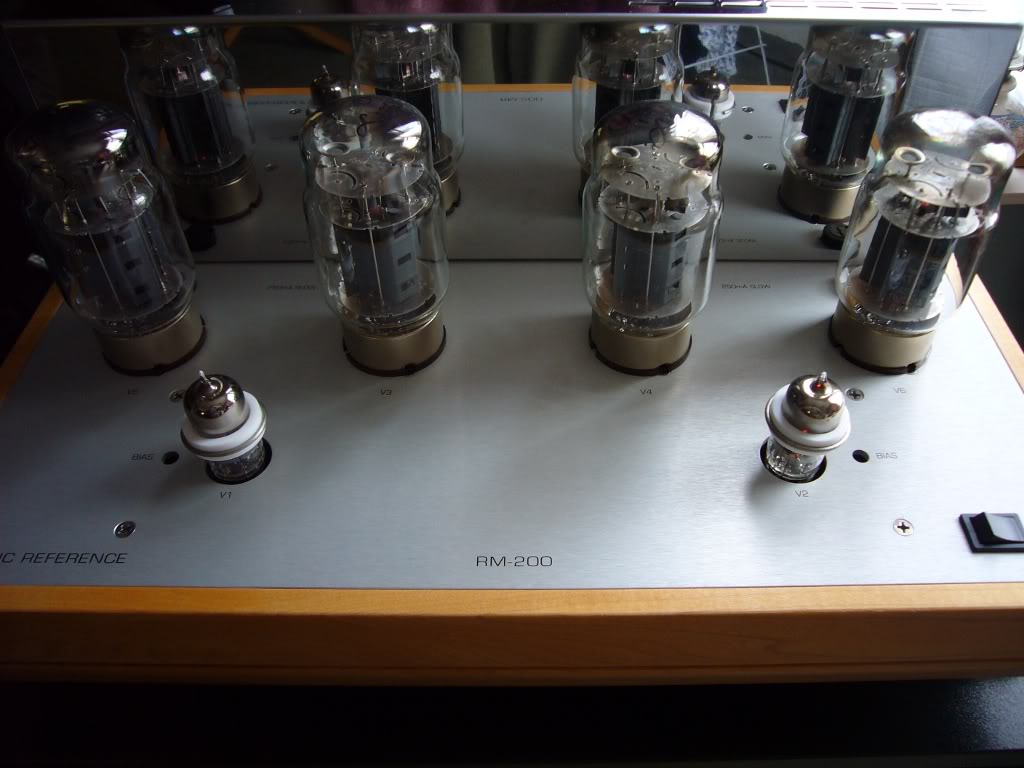
    Well as you may or may not know from two of my threads in this section of the forum...I have been down an amplifier;as one of its valves had gone. Thanks to Marco a set of nice Svetlana Cryo KT88 valves arrived yesterday, only slightly used.


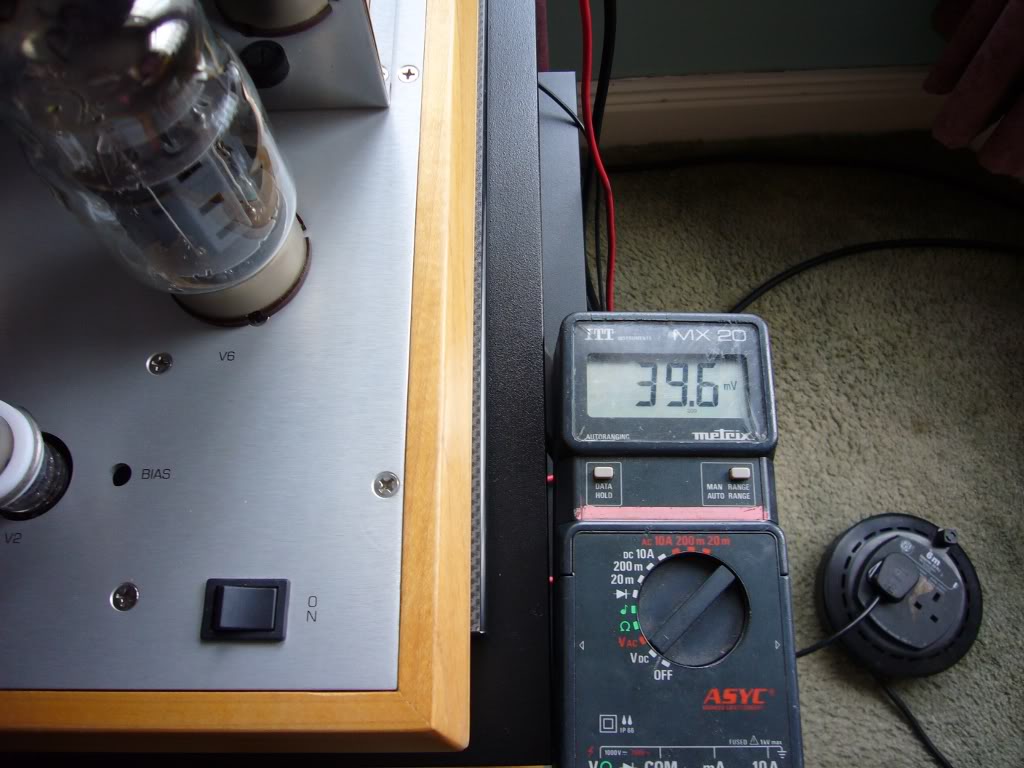
    With the Music Reference RM200 you have to set the bias of the valves. In the case of the RM200 this must be between 36mv and 44mv. The Rm200 is a parallel push pull amplifier so both sets of valves must be matched...otherwise as there is only one bias adjuster per channel it would be very difficult if not impossible to adjust the bias properly. As Rodney Hanna pointed out to me this afternoon in his opinion a bit of a weakness as it really does mean the valves need to be very closely if not identical in their matching. Individual bias pots would allow for a larger discrepancy in this area (though matching is best).

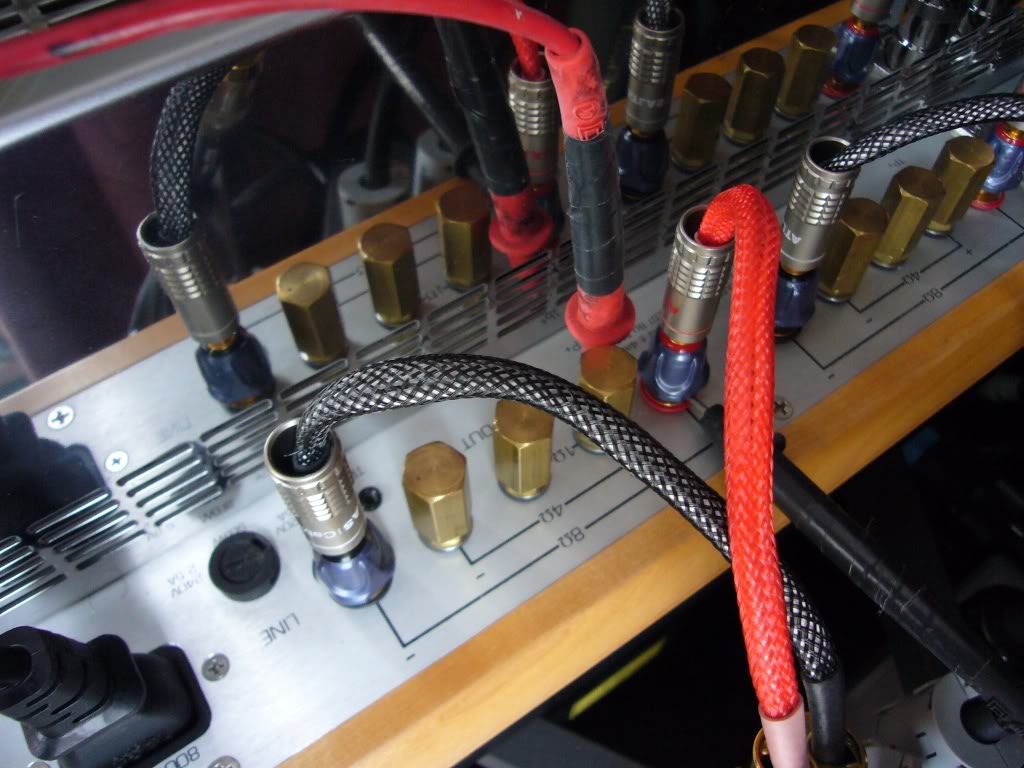
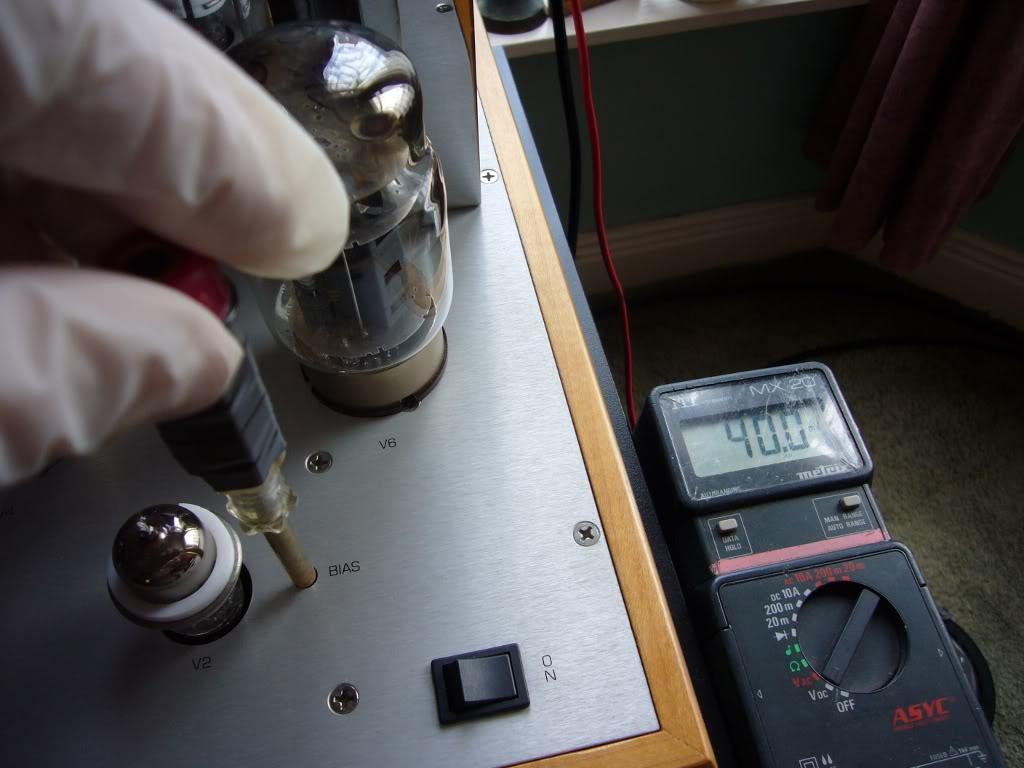
    I began my making sure everything I needed to know was known and the Digital Volt meter was set correctly....Black probe in Coms and Red probe in Volts/omega. I set the dial to Volts DC as per the amplifiers instruction book and then allowed the amp to warm up. In the case of the RM200 the designer says 15 minutes is enough to get things up and running. I left the amp on for that time and then located the TP points at the back of the amp. You place your Red probe into the first TP point for that set of valves and the Black into the closest 8 Ohm speaker post to that TP point.


    With the left channel first I did a reading for both valves using the + and - 8 ohm posts and the same for the Right channel. Without adjustment both sets of valves were to high 64mv and 75mv, so using an electricians screw driver I turned the individual pots slowly clockwise to reduce the bias, which I could follow on the DVM's screen.


    You will need to check the readings over the course of about an hour, just to make sure everything is nice and stable and the readings are not leaping about all over the place.


    Alas for me I had some problems with this...The readings for the two middle valves seemed to suggest they needed to be swapped over. After things had cooled down after the amplifier was switched off (YOU MUST DO THIS)I powered it back up and took readings again I was able to get the right channel nice and stable but not the left. The right channel stabilised at 39mv and 40mv...but the left would not. Valve one was set at 39mv and two at 36 but they kept drifting. The best I got it to, was 38mv and 40mv. However a slight noise started on the left channel and the readings went off. I ended up with 35mv and 58mv....before I switched the amp off.

    It would seem that the second valve position on the left channel is compromised in some way. Either a fault exists which took out the old valve or when it failed it damaged something under the valve base. I think it to much of a coincidence for this position to be a problem again, for there not to be something wrong. I spoke to Rodney and he agrees it needs to be checked out.......great a 160 mile round trip to do so.


    I had hoped this would be a happy little write up, and I would be able to wax lyrical about the Svetlana valves....but alas no. However I wanted to share the procedure of setting bias with you all, as its really not that hard to do. I did take a few precautions such as wearing rubber gloves(No jokes Marco I am not really in the mood and rubber soled slippers and I used extra insulation tape on the screw driver handle and DVM probes. One needs to be careful as there are lethal voltages present in all electronics, but perhaps more so in valve amplifiers, and normally I really would not recommend sticking anything into the guts of a valve amp....let alone a metal bladed screw driver.

    So I am back to Sand amplification again...at least for awhile.


    Watch this space for the outcome of this saga....


    Regards D S D L
    Last edited by Spectral Morn; 07-05-2009 at 16:44.
    Regards Neil

  2. #2
    Join Date: Mar 2008

    Location: Galashiels

    Posts: 14,031
    I'm inthescottishmafia.

    Default

    Did you try swapping the pairs of valves round at all? i.e. miz and match to see if you could get better readings? You really don't need to worry too much about matching each channel exactly,as long as each channel is within the spec.As for buying matched valves,IMHO even getting a set of perfectly matched valves would be a total waste of time,as within a couple of months,they would drift anyway,and the readings would be nothing like when they were new.Near enough really is good enough!
    If you would like to have the amp checked out,may I suggest contacting Nick Gorham on Audio Talk.I'm sure he'd be happy to take a look at it for you,and maybe you could have some nice coupling caps fitted at the same time.There's not much Nick doesn't know about valve amps,and he does repairs for some commercial companies,so you can rest assured the amp would be returned in perfect working order.

  3. #3
    Join Date: May 2008

    Location: Bristol, UK

    Posts: 9,966
    I'm Nick.

    Default

    Neil... Interesting write up, as always. On the point of silicone gloves; when I was younger I used to do theatre lighting at school and I was taught to be scrupulous about getting fingerprints on the bulbs. I don't know about how hot valves get, but grease etc on the glass was known to reduce the life of theatre bulbs, so it seems a wise precaution to take when handling valves as well, apart from the electrical protection aspect.

    Apologies if this is 'suck eggs' stuff. I'd be interested in what other people think on this.
    [SIZE="1"]Nick

    Follow AOS on Twitter: @AoS_Forum

  4. #4
    Join Date: Mar 2008

    Location: Galashiels

    Posts: 14,031
    I'm inthescottishmafia.

    Default

    Yes I've heard the same thing several times before.Never bothered about it really.Never had a valve fail on me yet! (Touch Wood!)

  5. #5
    Join Date: Nov 2008

    Location: North Down /Northern Ireland/ UK

    Posts: 19,474
    I'm Neil.

    Default

    Quote Originally Posted by Ali Tait View Post
    Did you try swapping the pairs of valves round at all? i.e. miz and match to see if you could get better readings? You really don't need to worry too much about matching each channel exactly,as long as each channel is within the spec.As for buying matched valves,IMHO even getting a set of perfectly matched valves would be a total waste of time,as within a couple of months,they would drift anyway,and the readings would be nothing like when they were new.Near enough really is good enough!
    If you would like to have the amp checked out,may I suggest contacting Nick Gorham on Audio Talk.I'm sure he'd be happy to take a look at it for you,and maybe you could have some nice coupling caps fitted at the same time.There's not much Nick doesn't know about valve amps,and he does repairs for some commercial companies,so you can rest assured the amp would be returned in perfect working order.

    Hi ali

    Yes I did swap the tubes around.

    On the first adjustment period I heard after about 40 mins of being on, some crackling from the left channel...I checked the readings right side okay left not(this is where the valve went)I tried adjusting again and figured I would swap the two middle valves round as the third one measured closer to the first on the left and the second on the left measured more like the fourth one. I thought this might help me get things a bit closer.

    I did this but while the right side was okay after readjusting and stayed so the left didn't. After being on for about 20 mins the crackling came back on the left side and I rechecked the bias. The second valve position second valve in series to the first (left channel) was rocketing from 40 to 58 and climbing. I figured the blown valve must have caused a problem...so I switched it off rather than risk another wrecked valve. I rang my engineer and he agreed that either a fault had caused the first valve to go or it going caused a problem.

    I am sure your recommended engineer would be very good but with the luck I am having at present it would probably end up smashed in transit. To be honest I can't afford it anyway...money is running out and valves and Mikes radio etc I can't really afford to spend anymore money this way. I will take the amp to Rodney hes a great guy and I can discuss the caps with him for the future.

    Hi Nick

    The Gloves were purely for extra electrical (maybe not thick enough) safety....cotton gloves are more suitable for changing valves. I am not to anal about this but maybe I should be. Your right about some issues arising out of light bulbs halogen etc and projector bulbs. The I-Max projector bulb is changed by guys in bomb proof suits...no dust, no dirt, no grease from finger prints. These bulbs are so big that if one blew or was dropped when changing the people doing it could be killed.


    Regards D S D L
    Regards Neil

  6. #6
    Join Date: Mar 2008

    Location: Galashiels

    Posts: 14,031
    I'm inthescottishmafia.

    Default

    No worries Neil,hope you get it fixed.Sounds like you have a blown cap and/or resistor on that side.Should be pretty easy to fix.

  7. #7
    Join Date: Nov 2008

    Location: North Down /Northern Ireland/ UK

    Posts: 19,474
    I'm Neil.

    Default

    Quote Originally Posted by Ali Tait View Post
    No worries Neil,hope you get it fixed.Sounds like you have a blown cap and/or resistor on that side.Should be pretty easy to fix.

    Sounds about right.....thanks for your interest.....cheers


    Regards D S D L
    Regards Neil

  8. #8
    Join Date: Mar 2008

    Location: Galashiels

    Posts: 14,031
    I'm inthescottishmafia.

    Default

    Let us know how you get on.

  9. #9
    Join Date: Feb 2009

    Location: Tokyo (originally coastal N.C., USA)

    Posts: 205

    Default

    Could a piece of trash gotten in the socket? Unlikely perhaps, seeing how careful you are Neil.
    Last edited by James G; 08-05-2009 at 06:53.
    James

    Denon DCD-755AE (Power supply mods, used as a transport)
    PS Audio Digital Link III (Power supply mods, Audiocom Superclock 4)
    Tricorp TRV-35SE (V-Cap Teflon and Wima MKP10 caps)
    KEF IQ5 (Bennic XPP caps and Jantzen MOX resistors)
    Yamaha YST-SW225 subwoofer
    Cables: Transparent Premium Powerlink, PS Audio xStream Prelude, Mark Grant DSP 2.5, Audioquest King Kobra, Audiotrak Glass Black

  10. #10
    Join Date: Nov 2008

    Location: North Down /Northern Ireland/ UK

    Posts: 19,474
    I'm Neil.

    Default

    Quote Originally Posted by jgarner71 View Post
    Could a piece of trash gotten in the socket? Unlikely perhaps, seeing how careful you are Neil.
    If only. Thanks for the suggestion (and this can cause problems so always look for dirt etc), but I fear its worse than that. The amp looks easy to work on, and Rodney my engineer friend is very good, he will get to the bottom of it fairly quickly.

    Regards D S D L
    Regards Neil

+ Reply to Thread
Page 1 of 2 12 LastLast

Posting Permissions

  • You may not post new threads
  • You may not post replies
  • You may not post attachments
  • You may not edit your posts
  •