+ Reply to Thread
Page 1 of 2 12 LastLast
Results 1 to 10 of 17

Thread: Diffraction and its effects . .

  1. #1
    Join Date: Jan 2008

    Location: Texas, yo. Can't seem to get away.

    Posts: 245

    Default Diffraction and its effects . .

    is something I've made a study of and custom make an affordable after market product for its removal. For those of you who don't know, diffraction is the reflection of waveforms shorter in length than the width of your speaker cabinets or those produced by your tweeters. This is not something owners of Gallo speakers, for example, or any baffleless speaker to include planars, need be concerned with. It is for the owners of box speakers with right or near right angles. Diffraction in action:

    http://www.silcom.com/~aludwig/images/diffdem.gif

    Those green and red circles in the illustration by Al Ludwig are not a part of any recording that you own and are additive in your frequency and time domains. They are redundant and late arriving, out of time and phase. Some speaker manufacturers, not very many, compensate for a rise in the frequency domain caused by diffracted waveforms summing in by reducing the tweeters output just above of the crossover, but the time and phase anomaly persists to the detriment of the clarity and dimensionality inherent in good recordings.

    I use organic wool and individually fit to the dimensions of most any speaker baffle and offer with a 30 day trial period. You should give it a try. You just might find that it is the best value audio investment you've ever made.

    Some user and reviewer comments can be seen on the back page at my website: www.diffractionbegone.com.

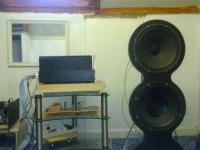
    An example can be seen in my avatar.
    Hear your music, not your speakers

  2. #2
    Join Date: Aug 2008

    Location: notts uk

    Posts: 297
    I'm Pete.

    Default

    think you need to go back and re check your assertion visa vi.. planars and baffels don't suffer.

    I to have studdied this effect. its a simple matter to show that a wave propgated from a plane on reaching an edge is refracted .

    you can set it up in your sink if you have a mind ...

  3. #3
    Join Date: Jan 2008

    Location: Texas, yo. Can't seem to get away.

    Posts: 245

    Question

    Zanash- Hi. Kindly give more information. I can't fathom what you mean by kitchen sink. Thanks.
    Hear your music, not your speakers

  4. #4
    Join Date: Feb 2008

    Location: http://www.homehifi.co.uk

    Posts: 6,289

    Default

    Aha, the good old water ripple experiment. Didm't that Dutch guy Huygens did something similar?

    Good luck to you Jim with your R&D and product development .

  5. #5
    Join Date: Jan 2009

    Location: Deleted

    Posts: 6,566
    I'm Deleted.

    Default

    I don't know if you will read this Jim, but Zanash is referring to the classic wave propagation/reflection experiment that involves making ripples on water and looking at how they are reflected.

    Planar speakers are not entirely free of a baffle though, as you suggest. At best they have a vestigial baffle - very few speakers have no support frame to hold the drive units in place (MBL perhaps and a couple of others). Planar speakers still produce horizontal dispersion and any edge will cause secondary diffraction to occur (dipole operation doesn't stop this).
    Account Deleted

  6. #6
    Join Date: May 2008

    Location: Cricklewood

    Posts: 9,074
    I'm ILOB.

    Default

    When I had standard box speakers this tweak really helped
    Loves anything from Pain of Salvation to Jeff Buckley to Django to Sarasate to Surinder Sandhu to Shawn Lane to Nick Drake to Rush to Beth Hart to Kate Bush to Rodrigo Y Gabriela to The Hellecasters to Dark Sanctury to Ben Harper to Karicus to Dream Theater to Zero Hour to Al DiMeola to Larry Carlton to Derek Trucks to Govt Mule to?

    Humour: One of the few things worth taking seriously

  7. #7
    Join Date: Aug 2011

    Location: Bacau, Romania

    Posts: 1,215
    I'm Bob.

    Default

    From the drive there is frame resonance (principally from the HF drive), and from the cabinet there is case resonance. The diagram implies there is a short wavelength waveform travelling almost like a skin effect from the tweeter. Is this intended to indicate the drive frame resonance?

    With tweeters face mounted on the baffle, could the drive resonance not be better deflected by a stubby cone fitted around the drive or rebating the drives?

    As my own DIY's were deliberately built with extra thick mdf and chamfered on all edges to reduce and mitigate cabinet edge resonance, and the flush faced drives filleted in rebates to deflect drive frame resonance, I thought I had dealt with all the possibilities.

    And no, I am not putting them into the bath to double check..........

  8. #8
    Join Date: Jan 2009

    Location: Deleted

    Posts: 6,566
    I'm Deleted.

    Default

    Quote Originally Posted by bobbasrah View Post
    From the drive there is frame resonance (principally from the HF drive), and from the cabinet there is case resonance. The diagram implies there is a short wavelength waveform travelling almost like a skin effect from the tweeter. Is this intended to indicate the drive frame resonance?
    No, the diagram represents the actual sonic output of the drive unit and the secondary diffraction of this sound wave as it meets edges such as the edge of the cabinet, or tweeter mounting plate etc.

    Quote Originally Posted by bobbasrah View Post
    With tweeters face mounted on the baffle, could the drive resonance not be better deflected by a stubby cone fitted around the drive or rebating the drives?
    Both of these options will effectively horn load the tweeter to some extent and significantly alter its output. Even then, secondary diffraction effects will still exist at the edge of the cone, or the hole that the drive unit is rebated into.

    Quote Originally Posted by bobbasrah View Post
    As my own DIY's were deliberately built with extra thick mdf and chamfered on all edges to reduce and mitigate cabinet edge resonance, and the flush faced drives filleted in rebates to deflect drive frame resonance, I thought I had dealt with all the possibilities.
    Both of these are excellent techniques for dealing with this problem. However, a sharp edge of a 45 degree chamfer will still cause an element (but reduced) of diffraction. Many speakers have rebated tweeters but relatively few use chamfered cabinet edges.Even then, in many cases, there exists the potential for diffraction to take place where the actual tweeters are mounted to the tweeter face-plate (although Jim's solution doesn't address this issue (some tweeter manufacturers seem to consider it more than others).
    Account Deleted

  9. #9
    Join Date: Aug 2011

    Location: Bacau, Romania

    Posts: 1,215
    I'm Bob.

    Default

    Ok Mark understood that this is from the drive element itself, but is this an effect only with HF and tweeters, and with respect to all tweeters?
    The reason I am asking is that when I checked this out with the manufacturer of the ribbon tweeter, the response was that such incorporation was unnecessary due to the cavity design, but if I had other reasons to do so (which I did) then proceed. I supposed it is a form of waveguide...

  10. #10
    Join Date: Jan 2009

    Location: Deleted

    Posts: 6,566
    I'm Deleted.

    Default

    The effect becomes less relevant as frequency descends and the wavelength lengthens.

    I would say that what the ribbon tweeter guys have told you isn't really true as such. Mounting the ribbon in a recess doesn't directly address the issue, which is endemic to the propagation of high frequencies. However, the more directional the output of a tweeter is, the less likely the problem is to occur.
    Account Deleted

+ Reply to Thread
Page 1 of 2 12 LastLast

Posting Permissions

  • You may not post new threads
  • You may not post replies
  • You may not post attachments
  • You may not edit your posts
  •