
+ Reply to Thread
Page 1 of 2 12 LastLast
Results 1 to 10 of 16

Thread: Absolute phase and integrated cartridge/arms

  1. #1
    Join Date: Jan 2009

    Location: Essex

    Posts: 37,740
    I'm openingabottleofwine.

    Default Absolute phase and integrated cartridge/arms

    Once again I seem to have approached another millennial posting. And again, on these occasions, this post will report my musings on aspects of music reproduction. Unfortunately this millennial post has come up on me somewhat unawares, so I don’t really have a single subject on which to write: in place I’ll discuss two topics that have recently engaged my thoughts and listening. I have yet to come to any definite conclusions with either of them, but maybe other members can contribute with their thoughts.

    The first topic is:

    How important is the preservation of absolute phase? Can we hear it?

    Before I discuss my attempts to see if I can detect a change of absolute phase, I ought to explain what is meant by ‘absolute phase’. The start of most notes occurs with an initial overpressure, caused by air being expelled from say the mouth, in the case of vocals and from the horns in the case of brass, woodwinds and reed instruments. This momentary overpressure is then picked up by a microphone and the positive going transient signal passed through the recording chain, so that on replay the speaker cones or diaphragms move towards the listener, themselves re-creating the momentary overpressure. The scenario is perhaps more obvious when one considers a drummer’s pedal operated kick drum: the drum skin nearest the pedal is initially pushed away and so too is the skin facing the audience and microphone. On replay the speaker cones should move out towards the listener as they mimic the behaviour of the drum skins.

    The situation is a lot less clear when it comes to plucked or bowed strings or with pitchless percussive instruments such as cymbals or snare drums. Or the initial transients of piano notes, another percussive instrument.

    So would it matter if instead of the speaker cone initially moving out, it moved in? Would it be the same as whistling a note by sucking rather than blowing? (Here I’m reminded of the line said by the sultry Lauren Bacall to Harry “Steve” Morgan (played by Humphrey Bogart) in the 1944 film of Hemingway’s To have and Have Not: “ You know to whistle don’t you Steve? You just put your lips together - and blow!”)
    http://uk.video.search.yahoo.com/vid...sigs=11auuq8ne
    (Apologies for the You Tube clip: it is a necessary piece of titillation to maintain your attention on what might seem to be a rather dull thread!)

    Many recordings are multi-miked and it is not at all obvious that the correct phase is preserved with them all, and even if a simple miking technique is used absolute phase may not be preserved track-to-track.

    Few preamplifiers have a phase inverting switch and those that do, tend to be of US design and manufacture. In fact it would seem that American audiophiles are far more concerned and aware of absolute phase; even going so far as to mark up their recordings if correction has to be made.

    One of my preamplifiers (a Mark Levinson ML26) has a phase inverting switch, so I thought I would listen to a few recordings featuring the vocals, horns and bass drumming with the phase switch in both positions (0º and 180º). I should also point out that the power amplifiers I use (Quad 405-1, heavily modified; Quad 405-2, lightly modified and the Quad 520f, unmodified) are phase inverting, but I have never deliberately corrected for this: so I have been listening to incorrect absolute phase for at least thirty years!


    (Image: Wikipedia. The phase inversion switch is top left.)

    The recordings I used were as follows:

    Joan Baez ‘5
    Sandy Denny ‘Sandy
    Nina Simone ‘Nina Simone at Newport

    Miles Davis ‘Kind of Blue
    John Coltrane ‘Giant Steps

    The Who ‘Tommy’, for Keith Moon’s drumming on ‘Underture’.
    Cream ‘Fresh Cream’, for the track ‘Cat’s Squirrel

    Clearly the tests were not blind, but I listened to all the recordings four times, twice with the phase switch in one position and twice with the phase switch in the invert position. I also listened to each recording and changed the switch during the track. Such a move is fraught with error as there is momentary delay of a few milliseconds and ‘instantaneous’ changes are often misinterpreted.

    The listening tests took place over several days, so as to minimise listening fatigue with notes being taken. Sadly I have to confess that I could not reliably hear any difference at all. In some ways I’m glad, as that is one less thing to worry about, but maybe I’m missing something. Are other members sensitive to the correct reproduction of absolute phase?


    The second topic is:

    Is there an inherent advantage in using arms with cartridges, which have been designed for one another?

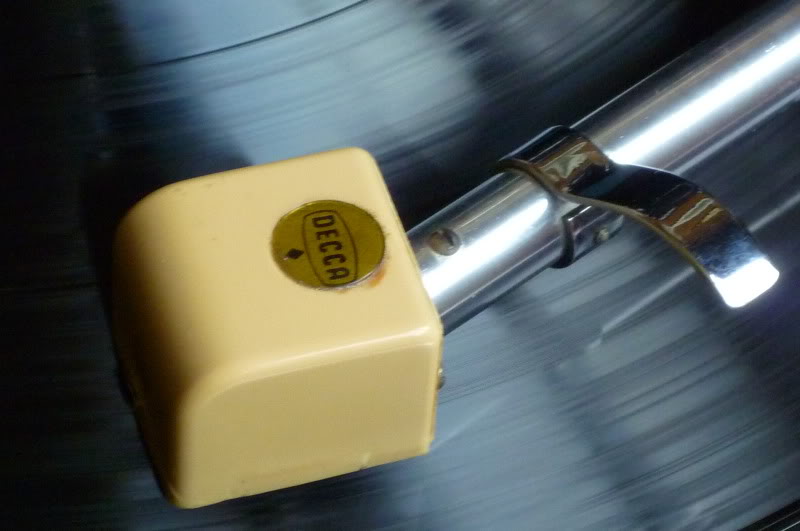
    The subject for this second topic came about recently through listening (and greatly enjoying) a vintage Decca cartridge and arm that had been designed for one another. Before I expand my thoughts on this, a little history is required.


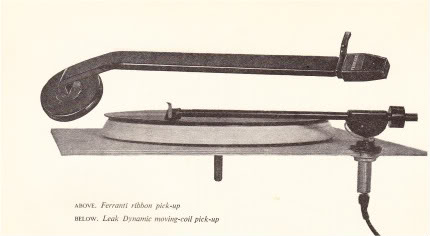
    In the early days of the microgroove record, (the early1950’s) there were few top quality cartridges available with which to play them. Those available were either developed by record companies themselves (Decca and EMI) or were developed by specialist audio companies (Ortofon, Shure, Tannoy, Leak and Ferranti, amongst others). All of these manufacturers supplied pick-up arms appropriate to their cartridges. The important thing to note was that these arms were designed to be used only with their respective cartridges (at that time usually referred to as a ‘head’) and with no other; indeed it was physically impossible to use a Ferranti ribbon cartridge in say a Decca arm and vice versa. This was all quite deliberate; the justification being that the arm was designed to offer the perfect environment for the cartridge to operate. Matters of tracking force, vertical tracking angle and stylus overhang were automatically set up, making installation that much easier. There was little standardisation in those days, apart from the adoption of either a 10” or 12” vinyl disc cut with a ‘microgroove’ whose dimensions had been standardised.


    Ferranti ribbon (top) and Leak moving coil (bottom) pickups
    (Image: ‘Hi-Fi for Pleasure’, Burnett James, Phoenix House Ltd, London, 2nd imp. 1956, p.48)


    (1948)


    (1954)
    Leak moving coil pickup integral with its own arm.
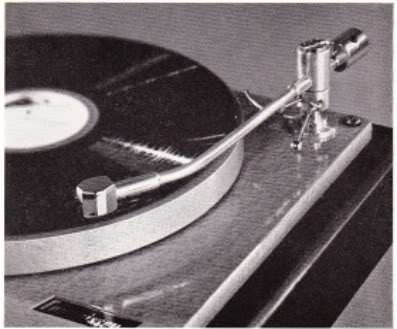


    EMI EPU 100 cartridge fitted to its uni-pivot pickup arm.
    (Image: ‘Tape Recording and Hi-Fi’, R. Douglas Brown, Arco, 1961)

    Standardisation of the cartridge/arm interface was slow to come. It was only through the adoption of the Ortofon bayonet coupling by SME that a more or less universal (now referred to as the EIA bayonet coupling) cartridge-arm interface was established. And the adoption would not have been as ubiquitous as it is, had it not been for the readily accepted SME arm design. Even so, within the broadcasting industry there were several manufacturers who ‘ploughed their own furrow’: EMT in Germany and Pierre Clement/Bordereau in France.

    It’s unclear when the ½” spaced fixings became standard for most cartridges, however being an Imperial measurement is likely to have been due to the Americans (Shure/SME ?) but however it arose, Ortofon and others were quick to adopt it.

    Even so, a couple of cartridge/arm manufacturers offered their products in two versions: a cartridge which could only be mated with its own arm and a cartridge having the same electrical and mechanical performance but with the now universal ½” spaced fixings: Decca with their Mk IV design and B&O with their SP6/7, 8/9 and later designs.

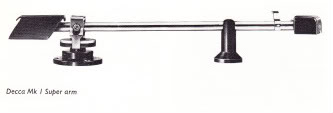
    I have a couple of pickup systems, which are either used with their own arms, or can be used in more universal arms having the EIA bayonet arm/headshell coupling. One of these is the EMT TSD15 cartridge used in the EMT 929 arm, or by using an adaptor (or through using the specially adapted EMT XSD-15) used in an SME arm. The second system is the Decca Mk. V or Mk. VI, used either in a headshell with ½” fixings or via an adaptor in a Decca ffss ‘Super’ arm (the adaptor is necessary to correct overhang and to convert from the three contact arrangement to the four-wire arm wiring).


    Decca Mk. III head fitted to a Decca ffss ‘Super’ arm.
    (Image: 1971 Hi Fi Year Book, IPC Electrical-Electronic Year Books Ltd)


    Decca Mk IV head fitted to Decca ffss ‘Super’ arm.
    (Image: BDH)

    Until now I had assumed that there was very little difference in performance, regardless of arm used, but recent experience with a Decca Mk. IV used in a Decca ffss ‘Super’ arm has caused me to reconsider my assumptions. (The ‘Super’ designation simply means the bearings have been up-graded to meet the higher compliance of the Mk IV over the Mk III.)

    So my findings are based on running an EMT cartridge either in an EMT 929 arm or in a damped SME 3009 (effective arm length and geometry is very similar to that of the EMT), and either a Decca Mk. V (aka “The Blue”, having a spherical tipped stylus) or a Mk. VI (aka “The Gold”, having an elliptical stylus) in the Decca ffss ‘Super’ (an arm having damped pivots) or in a damped SME 3009 (damping being effected through the use of the FD200 damping dashpot and (smallest) black paddle).

    In the case of the EMT cartridge (either fitted with a spherical or an elliptical stylus) I can hear no difference in its use with the two arms. The only difference between the two arms is the EMT uses needlepoint bearings in the vertical plane, the SME knife-edge bearings in the vertical plane.

    With the Deccas, things are subtler. With either a Decca V or VI mounted in the SME, handling noises are quite manifest, whereas they are completely absent when used in the Decca arm. Furthermore I feel the performance of either Decca cartridge has more poise and assuredness in its own arm than when used in the damped SME. It might be that knife-edged bearing arms are not best suited to Deccas, whereas those using either a damped unipivot or damped needlepoint bearings are. Despite this, I love my Deccas when used in an SME (and others have heard Deccas used in an undamped arm with needlepoint bearings) for all the things that Decca cartridges do so well. It is only for the sake of expediency that I use SME arms so much: I am very tempted to permanently set up the Decca ffss arm or possibly to dig out my old Audio & Design M9BA mercury contact(!), damped unipivot arm. It’s only finding that Decca cartridges are just so well behaved in their own arms (which after all, is precisely what the engineers at Decca wanted to achieve) that have caused me to have these thoughts.
    Last edited by Barry; 26-03-2020 at 20:11. Reason: punctuation and grammar
    Barry

  2. #2
    Join Date: May 2008

    Location: Lancaster(-ish), UK

    Posts: 16,936
    I'm ChrisB.

    Default

    Barry, you can always be relied upon to supply a great thought provoking thought or two for your landmark posts!
    Thanks for this, it's a great way to celebrate 4,000 posts on AoS.

  3. #3
    Join Date: May 2008

    Location: Lancaster(-ish), UK

    Posts: 16,936
    I'm ChrisB.

    Default

    Speaking as a newcomer to all this Decca-ownership business, I've come to an interesting discover which trumps any reputation that made me think I knew what they could & couldn't do.
    Two of the best systems I've ever had the pleasure of spending any time with made use of Decca cartridges. But when it came to considering actually owning one, there was always the thought in the back of the mind that there was a reputation for horrendous mistracking (I never fell for the 'it'll recut the grooves in all your prized vinyl' story).

    Since taking ownership of the Mk. IV pictured above, along with the accompanying arm, I have been astounded at the abilities of this combination. So much for tales of mistracking horrors, it's able to play two records in particular that I've never been able to enjoy with my Gyro/Zeta/Koetsu Black set up. I recently pronounced one of these albums (the recent mono pressing of the first Doors album, printed for record store day) as the worst pressing of any album I have ever bought. Well, I have to take it all back as the Decca traced this like a dream, not a problem in sight, and sounding totally compelling with it.

    I can't tell whether this is solely a function of the cartridge, or in combination with the arm. And I don't suppose I ever will because of the inability to mount another cartridge, but I do know that the result is absolutely fabulous, & I will be sampling some more of this Decca stuff in the future.

  4. #4
    Join Date: Jan 2009

    Location: Essex

    Posts: 37,740
    I'm openingabottleofwine.

    Default

    Haha, I'm sure a certain owner of a well regarded audio magazine would be interested in your findings Chris. Suffice it to say that he is not a Decca enthusiast and claims some of his records have been damaged due to playing them with a Decca cartridge!

    Regards
    Barry

  5. #5
    Join Date: May 2008

    Location: Lancaster(-ish), UK

    Posts: 16,936
    I'm ChrisB.

    Default

    Hmmm, yes well, when you become a 'deity', your word is absolute. To admit fallibility is just simply not an option is it?

  6. #6
    Join Date: Mar 2010

    Location: Cardiff

    Posts: 397
    I'm Rockabilly.

    Default

    Barry - an excellent post.

    The investigation into the phase alignment of a discrete system is an interesting exercise. It's relationship to the recording process however, is as you say, not obvious and I would suggest weak enough not to be audible.

    During the recording sessions that I've engineered and the gigs that I've mixed, management of signal phase from mic to console is limited to 180 degrees, via either phase changing cables or inverting switches on the desk.
    Management of phase between instrument and mic is additionally limited by the engineer's skill in mic placement. Not that a totally phase coherent response between the incident waveform and the mic diaphragm is necessarily desirable or entirely achievable. It may not be desirable in terms of frequency response and it may not be possible when close miking due to rippling effects on the diaphragm or ribbon.
    Most non-orchestral percussion instruments are recorded by more than one transducer. For example, a bass drum in rock music is recorded by a minimum of two mics. One will be placed near the centre or rear of the drum and will be a large diaphragm type or boundary effect type for capture of bass frequencies. A second, different mic - capable of withstanding high SPL - will be placed near the batter skin, and will capture the 'click'. The phase relationship of the output signal of these two mics is complex. It's quite possible to have two or three mics per instrument contributing to a multi-track mix, which is then manipulated via several further processes. Once all of the ingredients in the pudding have been kneaded and baked, to say that the net movement of drivers in a playback system is directly proportional to the original phase relationship of an individual recorded instrument and transducer is too simplistic.

    Ambient real-time recording, still regularly employed in orchestral sessions, is similarly non-linear. Consider a classic coincident or spaced pair arrangement of microphones placed tens of metres from the performers. The phase differences between the two mics is exactly what the brain uses to decipher stereo image and soundstage. However, the incident pressure wave on each mic is an interference of direct and reflected sound, the phase relationship of which is rather knotty. So, even before dynamic processing such as compression, fx processing such as digital reverb and all the mastering hoo-ha, phase coherence isn't coherent.

    So, I would expect you not to hear any discernable difference, because simply inverting the phase of your speaker system can't possibly improve the correlation between the programmed, processed music of your source and the original performance.
    Last edited by camtwister; 17-06-2011 at 00:26.
    Johnny Dodgem.

    Cartridges vintage MMs including Pickering xsv-4000/xsv-3000 : Stanton 881s/D81 : AT140LC/VMN40ML
    Spinners hot rod 1210 (Jelco 750D, Origami, Ammonite, Longdog, Vantage, Achromats) : Pye G63 & Garrard AT6 : Two full custom Lencos : Kenwood KD-650D
    Streaming Qobuz : BluOS & Node2 (Fidelity Audio modified) : RME ADI-2 DAC
    Pre-amps Tron Seven (GT modified) : Conrad Johnson EV1 : Croft Micro 25 : Decware ZStage
    Power Amps PrimaLuna ProLogue 5 (KT120) : PrimaLuna ProLogue 4 (KT77)
    Speakers The Edingdale : Meadowlark Hot Rod Shearwater
    Room Acoustic Artnovion absorbers & diffusers : Sonarworks & Dirac dsp

  7. #7
    Join Date: Jan 2008

    Location: Wrexham, North Wales, UK

    Posts: 110,531
    I'm AudioAl'sArbiterForPISHANTO.

    Default

    Indeed, Barry - an excellent post... Here's to your 5000th!

    I recently pronounced one of these albums (the recent mono pressing of the first Doors album, printed for record store day) as the worst pressing of any album I have ever bought. Well, I have to take it all back as the Decca traced this like a dream, not a problem in sight, and sounding totally compelling with it.
    Chris, just a quick thought, by any chance is the Doors album recorded on the Decca label?

    Marco.
    Main System

    Turntable: Heavily-modified Technics SL-1210MK5G [Mike New bearing/ETP platter/Paul Hynes SR7 PSU & regulator mods]. Funk Firm APM Achromat with Nagaoka GL-601 Crystal Record Weight. Isonoe feet & boots. Ortofon RS-212D tonearm with Denon DL-103GL, in a Denon PCL-300 headshell, fitted with Funk Firm Houdini and Kondo SL-115 pure-silver cartridge leads.

    Paul Hynes MC head amp/SR5 PSU. Also modded Lentek head amp and Denon AU-310 SUT.

    Other Cartridges: Nippon Columbia (NOS 1987) Denon DL-103. USA-made Shure SC35C with NOS stylus. Goldring G820 with NOS stylus. Shure M55E with NOS stylus.

    CD Player: Audiocom-modified Sony X-777ES/DAS-R1 DAC.

    Tape Deck: Tandberg TCD 310, fully restored and recalibrated as new by RDE, plus upgraded with heads from the TCD-420a. Also with matching TM4 Norway microphones.

    Preamps: Heavily-modified Croft Charisma-X. Power Amps: Tube Distinctions Copper Amp, fitted with Tungsol KT-150s. Quad 306.

    Cables & Sundries: Mark Grant HDX1 interconnects and digital coaxial cable, plus Mark Grant 6mm UP-LCOFC Van Damme speaker cable. MCRU 'Ultimate' mains leads. Lehmann clone headphone amp with vintage Koss PRO-4AAA headphones.

    Tube Distinctions digital noise filter. VPI HW16.5 record cleaning machine.

    Speakers: Tannoy 15MGs in Lockwood cabinets with modified crossovers. 1967 Celestion Ditton 15.

  8. #8
    Join Date: May 2008

    Location: Lancaster(-ish), UK

    Posts: 16,936
    I'm ChrisB.

    Default

    Actually, no it's not. It was originally on Elektra, but the reissue is a Rhino.
    However, (and I see what you're getting at) some of the best moments I've had with this combination so far have been with some old Decca classical pressings, such as this one:


    Recorded in 1955, 1958 & 1959 - this album is the most musical thing ever to emerge from Walthamstow! Those Decca triangle releases are sought after for a reason.

  9. #9
    Join Date: Jan 2008

    Location: Wrexham, North Wales, UK

    Posts: 110,531
    I'm AudioAl'sArbiterForPISHANTO.

    Default

    Yep, it was just a thought.

    As you know, Decca were amongst a select group of cartridge manufacturers who also had their own record label, therefore it's not surprising that their cartridges will have been voiced using their own recordings, especially considering the various RIAA equalisation curves used in those days by record companies.

    So don't be surprised if all your Stones albums sound fab, too!

    Marco.
    Main System

    Turntable: Heavily-modified Technics SL-1210MK5G [Mike New bearing/ETP platter/Paul Hynes SR7 PSU & regulator mods]. Funk Firm APM Achromat with Nagaoka GL-601 Crystal Record Weight. Isonoe feet & boots. Ortofon RS-212D tonearm with Denon DL-103GL, in a Denon PCL-300 headshell, fitted with Funk Firm Houdini and Kondo SL-115 pure-silver cartridge leads.

    Paul Hynes MC head amp/SR5 PSU. Also modded Lentek head amp and Denon AU-310 SUT.

    Other Cartridges: Nippon Columbia (NOS 1987) Denon DL-103. USA-made Shure SC35C with NOS stylus. Goldring G820 with NOS stylus. Shure M55E with NOS stylus.

    CD Player: Audiocom-modified Sony X-777ES/DAS-R1 DAC.

    Tape Deck: Tandberg TCD 310, fully restored and recalibrated as new by RDE, plus upgraded with heads from the TCD-420a. Also with matching TM4 Norway microphones.

    Preamps: Heavily-modified Croft Charisma-X. Power Amps: Tube Distinctions Copper Amp, fitted with Tungsol KT-150s. Quad 306.

    Cables & Sundries: Mark Grant HDX1 interconnects and digital coaxial cable, plus Mark Grant 6mm UP-LCOFC Van Damme speaker cable. MCRU 'Ultimate' mains leads. Lehmann clone headphone amp with vintage Koss PRO-4AAA headphones.

    Tube Distinctions digital noise filter. VPI HW16.5 record cleaning machine.

    Speakers: Tannoy 15MGs in Lockwood cabinets with modified crossovers. 1967 Celestion Ditton 15.

  10. #10
    Join Date: Nov 2008

    Location: Valley of the Hazels

    Posts: 9,143
    I'm AMusicFanNotAnAudiophile.

    Default

    Quote Originally Posted by Marco View Post
    Yep, it was just a thought.

    As you know, Decca were amongst a select group of cartridge manufacturers who also had their own record label, therefore it's not surprising that their cartridges will have been voiced using their own recordings, especially considering the various RIAA equalisation curves used in those days by record companies.

    So don't be surprised if all your Stones albums sound fab, too!

    Marco.
    Sorry to have to be pendantic, but isn't the word various superfluous ?
    It's either RIAA or it isn't
    Other than that I'm inclined to agree with you.
    Chris


    Common sense isn't anymore!

+ Reply to Thread
Page 1 of 2 12 LastLast

Posting Permissions

  • You may not post new threads
  • You may not post replies
  • You may not post attachments
  • You may not edit your posts
  •